
The Long Grave
Little John and the Mystery of the Hathersage Giant
A Hooded History
When I look back at the characters and events that inspired my interest in history as a child, I struggle to think of anything more potent than the legend of Robin Hood.
There were two great big picture books I would pore through time and time again, on rainy Sunday afternoons; one on King Arthur and the other, Robin. Errol Flynn’s 1938 movie The Adventures of Robin Hood was played so much on an old VHS tape in my house that it literally burned out, and the animated Disney movie about Robin, who was played by a fox, was just as equally weathered too. I can still whistle the theme tune. Yet, until writing this piece, the sheer scale of this influence had somewhat drifted from my mind.
The landscape of ideas that has grown around the figure of Robin is vast, but a central essential question about him is still as simple now as it ever was; did he actually exist? One view would say no, and that Robin is an amalgamation of various rebel figures from the later medieval period that have become bound together to form a coherent whole. Another view, however, will have us scouring the historical records for potential real-world connections to living, breathing figures.
Naturally, without Robin, we don’t have his band of Merry Men, and therefore, we can’t possibly have the subject of this piece, Little John, being buried in Derbyshire, or anywhere else.
The earliest reference to Robin comes in the allegorical poem Piers Plowman, written by William Langland during the 1370s, in which a troubled priest states that whilst he ‘may not know the Lord's Prayer, I know the rhymes of Robin Hood’ - something given to imply the priest in question was more inclined to pop culture than matters of the Church. It shows us that by the late fourteenth century, tales of Robin were already widely known, which in turn suggests a much earlier origin.
These ‘rhymes’ were ballads favoured in taverns, typically performed in unison whilst drinking. Their detail is striking. As is their violence.
In Robin Hood and the Monk, Robin is turned over into the sheriff’s clutches by a monk, who is subsequently tracked down on his way to the king’s court by Little John and Mutch the Miller’s Son, who then decapitate both the monk and his young assistant. The ballad celebrates the event, with reverent vigour. In another, Robin cuts off the head of a monk before holding it aloft and mutilating his face on the tip of his sword. It's Tarantino for the Middle Ages. No one, it seems, was trouncing around in green tights with a feather in their cap.
Robin, Little John, and their band of followers, from the ballads at least, were very violent men, even by the standards of a very violent age.
It is worth noting from these early tales that Little John is present from the off, and this may suggest that Robin and his core story has been a coherent body for as long as it has been known. From the fifteenth century, we have even more ballads and tales, and here we find that same penchant for ultra-violence, now coupled with the characteristics we more commonly associate with the figure today.
In A Gest of Robyn Hode, we find examples of his image as the more lovable outlaw. Accosting a knight on the road, Robin and Little John discover the knight is down on his luck and owes a great debt to an abbot in Yorkshire. Failure to repay the abbot on time will mean the knight’s estates will in turn be forfeited. Robin’s response? He gifts the knight the £400 needed to repay the loan.
It is from this work that we get our classic elements of the common story too; the archery contest in which Robin splits an arrow is one notable example, as are references to his arch nemesis, the Sheriff of Nottingham. Outside of the fiction and revelry so associated with the ballads, we also have the avenue of genuine historical record to consider too.
Pretty much all of the potential targets that reach the historical record post-1350 are ruled out instantly, on the basis that the mention of Robin by Langland points to a figure active during the preceding century. Our attention then, most logically points to a certain Robert Hod named in the York assizes of July 1225, again in 1226, and then in eight successive pipe rolls running until 1234.
It is a notable, unusually large number, suggesting this Robert Hod was an outlaw of serious contention and continued success. We should note that the 1227 entry also specifically shows that a debt is owed to the Liberty of St. Peter’s in York (the modern minster site), and is a direct correlation to the early stories of Hood, his association with Yorkshire, and of course, the debt of the knight.
Not only this, but Eustace of Lowdham, the Sheriff of Yorkshire for 1225-1226 was also a forest justice, and became Sheriff of Nottingham in 1232. Eustace would have been the man directly responsible for the collection of the penalties authorised by Robert de Lexinton; the man that sat in judgement on the aforementioned Robert Hod.
It is quite possible then, that an outlaw by the name of Robert Hod (actually recorded as Hood in several records of the time) had achieved sustained success over ten years during the early to mid-thirteenth century, and that a single figure of authority, who would become the Sheriff of Nottingham, had been chasing his tail since at least 1225. It would have been quite the story at the time. Exactly the kind of thing folks would sing about in local taverns. For me, it's so close to the legend, that I’ll happily take it as my Robin.
But this piece is not about Robin, it is about Little John, his commander-in-chief of forest outlaws. If we can accept that Robin may well have existed, then what do we know about Little John; and how did he get his association with the village of Hathersage? Here's the thing; there’s an awful lot of historical evidence for an outlaw named Little John, way more than there is for Robin. Problem is, it all comes more than 100 years later than the Robert Hod of the 1220s.
Our first reference to the figure of Little John arrives in 1420, half a century on from Piers Plowman, by the chronicler Andrew of Wyntoun in his Orygynale Cronykil of Scotland, where he places both Robin and John as outlaws connected to Barnsdale in Yorkshire, during the preceding century.
Records attesting to Little John - or ‘John Petit’ - are numerous in the timeline. A certain John le Litel was amongst raiders named in connection with a complaint made by Simon de Wakefield in December 1318, when a band of Yorkshiremen stole £140 from his house at Hornington. In June 1323 too, a complaint was made to Yorkshire justice by Archbishop of York, William de Melton, that one John, known as Little John, had stolen deer from his hunting park in Beverley.
Similar instances are recorded across the next 30 or so years. As with Robin, it seems Little John may have been a renowned outlaw active across a fixed period, this time in the early fourteenth century. Again, precisely the kind of character folks would raise their ale to in the drinking dens of medieval England.
It would seem that two men, 100 years or so apart, may be seen as figureheads of an outlaw band operating primarily out of Yorkshire. Could it be that Robert Hod in the 1200s and Little John in the 1320s are men sharing a position, as leaders of the same rebel band, latterly immortalised in legend together as one?
The premise of two characters from differing times becoming contemporary companions in lore is certainly plausible. On balance, the evidence points to a likelihood that two such men did exist, but at least a century apart. For our inquiries into Little John, this is a tantalising prospect. Divorced from the need to have co-existed with the thirteenth century Robin, we can now explore John in his own right, and that possibility for a connection to Hathersage suddenly becomes a legitimate endeavour.
In a woodland world of sparse settlements, South Yorkshire and Derbyshire were neighbouring jurisdictions with indistinguishable borders to the outlaws living within their forests.
Hathersage and Little John
The village of Hathersage is a wonderful spot in the east of the Derbyshire Peak District, where towns and villages filled with pretty stone cottages and quaint, welcoming pubs are many, but few have all of that and 3000 years of history packed around them quite so vividly; let alone a legacy of world-class literary inspiration to boot.
A prominent feature of Hathersage is the magnificent St. Michael's Church, and it is here that we find direct connections to the world-famous Brontë family. Between 1845 and 1847 Charlotte Brontë would visit Hathersage on numerous occasions with her friend Ellen Nussey. Ellen’s brother Henry had recently become vicar of St. Michael’s and it was on these trips to Derbyshire that Charlotte would curate much of her inspiration for her classic novel, Jane Eyre. St. Michael's Church is said to have inspired the setting for the novel's famous wedding scene between Jane and Mr. Rochester, and the foremost family of the area at the time of Charlotte’s visits it should be noted, was in fact the Eyre family, resident at North Lees Hall.
There’s little wonder that the Brontë connection to the village provides a historical headline so bold that much other local history is cast in something of an understandable shadow. But it is in this shadow, and in that very same churchyard of St. Michael’s, that we head to now as we bring ourselves up to date with the matter at the core of this piece, as we stand beside what is said to be the grave of none other than Little John himself.
The final resting place of the legendary figure; what would you imagine it to look like? In all probability, a little like this, but only because the very idea of the man is so naturally tethered to our ideas of fantasy. A pretty, stone slab set at the head of the burial plot approximately 12 feet in length, guarded all around by a railing. And upon the stone, an inscription;
HERE LIES BURIED LITTLE JOHN
THE FRIEND AND LIEUTENANT OF ROBIN HOOD
HE DIED IN A COTTAGE (NOW DESTROYED)
TO THE EAST OF THE CHURCHYARD. THE GRAVE IS MARKED BY THIS OLD
HEADSTONE AND FOOTSTONE AND IS UNDERNEATH THE OLD YEW TREE
Atop the burial plot is set a second stone, declaring how the grave was subject to care undertaken by the ‘Ancient Order of Foresters Friendly Society’ in June 1929. This is a relatively recent amendment to what we must assume was once a much earlier, more ‘natural’ burial site. Even still, we know from local records that a version of the grave was on site by at least 1685, replete with both head and foot stones, drawing attention to the size of the man buried beneath.
Back again to the local folk record, we encounter the small matter of how a bow, cap, and horn were reputedly to be found hanging in the church during the 1600s too. So what do we know about the character's apparent association to the village?
By far the earliest direct correlation between Little John and the village comes from the Yorkshire writer Roger Dodsworth, who writing around the year 1619 made reference to a Robert Lockseley of Bradfield who, having wounded his stepfather, fled to the forest, and made friends with a ‘Little John’ who ‘is buried at Hathershead in Derbyshire’.
At that time, John’s headstone in Hathershead - or Hathersage - is said to have read ‘Mr Long saith…Little John was an Earl Huntingdon. After he joined with Much, the Miller’s son.’ These are clear references to characters within the traditional pantheon of Robin Hood legend and may be tempting to dismiss, however, what this reference does give us, is a view straight into the Hathersage of the early 1600s and the fact that by that time, the legend of Little John was already firmly planted in the village. Intriguing too is the first written reference to John’s belongings being stored in the church, which comes from a note in the Ashmolean Museum in Oxford, which states how;
‘The famous Little John lyes buried in Hethersedge churchyard in the peak of Derbyshire, one stone at his head, another at his feet, and part of his bow hangs in the chancel. Anno 1652.’
It appears we can have confidence that objects associated with Little John were indeed on site during the period, and likely had been for a century at least.
These are the earliest written notations concerning a connection with the village, and come the 1700s there are numerous popular accounts, peeling off from this central commentary, which begin to develop as they are published. Eventually, they lead to our first descriptions of an excavation of the grave itself, recorded in the late 1700s by various antiquarian writers.
Here we get our first glimpse of the legend that, when the grave was opened, it contained bones of usually large sizes, which were removed before a kind of mysterious curse took hold, leading to accidents for the local sexton, who then reburied them to end his misfortune. Entering the 1800s, and via Ebenezer Rhodes’ 1824 work Peak Scenery: or, The Derbyshire Tourist, the author describes his visit to the village and writes;
‘His burial place is distinguished by stones placed at the head and foot of his grave; they are nearly four yards apart, and are said to designate the stature of this gigantic man. However fabulous this account may be, the body here interred appears to have been of more than ordinary size. In October 1784, this reputed grave of Little John was opened, when a thigh bone measuring two feet five inches was found within it. A tall man from Offerton, who on account of his stature had probably obtained the name of Robin Hood’s faithful follower, was interred in this place - hence originated this village tradition; and that it might be rendered still more marvellous when the bones were re-committed to the grave, the stones that originally marked the stature of the tall man of Offerton were removed farther apart.’
Our provider of clues, Ebenezer Rhodes (1762-1839), has come to be regarded as a foremost historian of Derbyshire, but along the way, he lived quite a diverse life.
A renowned cutler and artist, he found fortune as a partner in a razor blade firm in the late 1700s. Throughout middle age his passion for local history began to develop, following repeated visits to Dovedale to sketch the landscape. It was a folio of his artistic work that formed the core of his Peak Scenery and which included his information on our subject; which also refers to that secondarily referenced Little John location in Hathersage, the big man’s family home, across the River Derwent at what became known as Nether House.
It is from this house, that in a repurposing of the famous Robin Hood trope, Little John rode out to a boundary stone on Offerton Moor and fired an arrow into the village with the request that he would be buried where it landed; which conveniently, was the church.
Courtesy of Spencer T. Hall’s 1853 collection The Peak and the Plain, we know that a certain Jenny Sherd was living in the suspected former cottage of Little John during the early 1800s, and was herself of longstanding belief that the house was indeed that in which the man had died hundreds of years before.
Jenny was said to have been a source of a further story regarding the opening of the grave, relaying how Captain James Shuttleworth brought a thigh-bone forth to the cottage in her youth, having cracked open the grave in the presence of a sexton by the name of Philip Heaton - at which her father measured the bone at thirty-two inches long. The average human femur is around eighteen; therefore even if we take the other accounts in existence of the bone length being closer to 24 inches as being more plausible, this would still make the owner of the femur around 8 feet tall!
Of the other associated items of Little John connected with Hathersage, his cap was said to have hung in the church during the period of the excavation, and this was apparently attested to by many elderly members of the village during the early 1800s.
The bow, recorded in the note from the Ashmolean, seems to have enjoyed something of a life of its own, and was reputedly removed from the church in 1729 by William Spencer - his wife Christiana had recently inherited the Hathersage estate - to be housed in his home at Cannon Hall, near Barnsley, where it was hung in the ballroom. This tethers well to the history. James Shuttleworth, the man who opened up the grave, was Williams’ nephew, and at the time of the excavation, a major local landowner himself. All in all, the issue of Little John in Hathersage seems to have been something of a family obsession.
Whoever really was in that apparently now empty grave, clearly the intrigue and fascination caused by the gravesite is nothing new; even the better part of 250 years ago, locals were so moved by curiosity to (literally) dig into the legend, the history of which was known firmly in the area from at least the early 1600s.
That alone, for me, is quite striking. Frankly, most similar notions elsewhere, where characters of England’s myth-laden past have been tethered to a locality or building, are complete Victorian folly. In Hathersage, we have something fundamentally different.
Outlaw to Forester
Assuming this won’t be considered a spoiler, there is no way to definitively tether the figure of the Little John of legend to the burial plot in Hathersage. Interesting to note, however, is just how chock full of associated place names the local area has historically.
There’s a Hood Brook, Little John’s Well, Robin Hood’s Cross, Robin Hood’s Croft, and of course, Robin Hood’s Cave up on Stanage Edge. Yet, there is one core consideration which more than any other leads me to turn away from that particular search from here on; the idea that an outlaw of any kind could take up residence in the village in such a formal setting as Nether House.
The latter medieval era was a tumultuous time marked by political unrest, economic challenges, and social upheaval. During the period, perhaps more than most, turning to a life outside the boundaries of society, becoming an ‘out-law’ was a serious business. There were essentially two ways such a declaration from local justice could come to be fostered onto a person.
The more traditional route is that of criminality. Genuine, violent, gangsters in green, living a life of crime and hiding out in the countryside as per our imaginations; or of course, you could arrive there purely by circumstance. Driven by desperation and hardship, illegal activities could easily become the only valid means of survival. Killing a stag, even killing a rabbit, if it belonged to the wrong family, death was an easy penalty to prescribe. Taking to the forests therefore, was a far more appealing option, but not one to be taken lightly.
Upon a crime being committed, and the sheriff being unable to bring the accused to justice, a process would be undertaken whereby at 5 successive sittings of court, the sheriff must declare the risk to the individual of ‘outlawry’. Once confirmed, not only could the accused’s property and possessions be forfeited unto the Crown, but ultimately they could be killed with impunity.
The dense forests of medieval England became havens for outlaws seeking refuge from the law, naturally, this also became a hunting ground in more ways than one. Outlaws, by their very nature, were social outcasts, forming their own communities with their own rules.
These groups were often comprised of individuals who had experienced similar hardships and shared a common sense of injustice; or an appetite for a bandit’s life. The entire idea of Little John living openly, in any location, if he were to exist in the manner myth has painted out for us, is just not possible. The man who was buried in Hathersage was something else entirely, the possibilities of which are likely best summed up by Dr Charles Cox, who in 1876 included the tale in his Churches of Derbyshire;
‘On the whole, the evidence warrants us in assuming that a portion of the weapons and accoutrements peculiar to a forester were hung up in a church, that the said forester (both from the bow and the grave) was of exceptional stature, that both weapons and grave were popularly assigned to Little John more than 200 years ago, and that the said weapons must have belonged to a man of extraordinary fame or they would not have found such a resting place. This being the case, the opponents of the accuracy of the tradition seem to have far more difficulties with which to contend than those who accept it.’
I find this the most sensible option. Coupling this with the association of Nether House, which is genuine and long-lasting in the local lore, we can pick as good a spot as any on the historical timeline as to benchmark the time from when the man in the grave originated.
The house was built during the late 1500s, so, at this point, we have a picture of an extraordinary local figure, a forester, living in Nether House in the late 1500s, who is then buried at the church during the early 1600s. Feels very neat. I like it. It works. Except, that would give absolutely no allowance for the elapsing time needed to create the Little John myth around his grave.
I think at this point, we have to rule out Nether House altogether. We should stick a hundred years on it at least, and assume the character in question was active somewhere between 1400-1500. Anything else, and such a figure would have found themselves remembered relatively well within 100 years of their death. There would simply be no need for the legend to arise in place of living memory.
The title of forester, during the period in question, was quite the diverse role. Besides overseeing the business interests of the woodlands for the landowner, they would also hold a position more akin to that of a sheriff in the immediate vicinity, taking care of poachers for their warden and of course, dealing with the issue of outlaws living off the land within their charge.
By the 1400s, the Manor of Hathersage had come to be held by the Longford family, who courtesy of the marriage between Nigel de Longford and Cecilia de Hathersage, circa 1225, and their service to King Henry IV during the latter part of the fourteenth century, had risen to become one of the most powerful families in the region. If we are to pick a place and time at all, it is most logically within this period that our great forester was in service to the woodlands of the Longford family.
In August 1424, Sir Ralph Longford was fighting in Normandy alongside the Duke of Bedford. He died in 1432 and his wife, Margaret Radcliffe would go on to marry a family lawyer, Seth Worsley; the bounty for which included the lands of Hathersage. The couple lived on until at least 1470, and it is therefore under their stewardship our forester was most likely in employment. There are of course, no definitive answers here, but the legend of Little John in Hathersage, so well attested on account of the physical evidence apparently harboured around the village and the church, began to enjoy its legendary status far earlier than most.
The roots of the tale most likely originated with a local forester during the 1400s, who on account of his physical size, came to embody the mythological image of Little John of Robin Hood fame. That is of course, unless we reconsider the assumed reality of a figure living in the 1400s needing only 200 years to pass into legend. Perhaps that wouldn’t be quite long enough to completely disrobe the real identity of the giant bowman buried at the church. Maybe 300 years is more accurate.
If so, when subtracted from the first mention of the legend appearing in the year 1619, we are taken back to that exact moment in the fourteenth century at which we find all of those captivating written references in the court rolls to the infamous outlaw himself; that legendary figure, and just maybe, the real Little John.
Eli Lewis-Lycett 2025
Sources and Further Reading
Regarding the early ballads;
- Knight, Stephen, and Thomas Ohlgren, eds. Robin Hood and Other Outlaw Tales. Kalamazoo, MI: Medieval Institute Publications, 1997.
- Dobson, R. B., and John Taylor. Rymes of Robyn Hood: An Introduction to the English Outlaw. 3rd ed. Stroud: Sutton Publishing, 1997.
- Piers Plowman. Edited by A. V. C. Schmidt. London: Everyman, 1995.
Regarding Brontë connections;
- Gordon, Lyndall. Charlotte Brontë: A Passionate Life. London: Chatto & Windus, 1994.
Regarding the historical Robin Hood;
- Yorkshire Assize Rolls, July 1225.
- Pipe Rolls of the Exchequer, 1226–1234.
- Holt, J. C. Robin Hood. London: Thames & Hudson, 1982.
- Dobson, R. B., and John Taylor. Rymes of Robyn Hood. Stroud: Sutton Publishing, 1997.
Regarding the historical Little John;
- Wyntoun, Andrew. Orygynale Cronykil of Scotland. Edited by David Laing. Edinburgh: William Paterson, 1872–79.
- Yorkshire legal and manorial records, 1318–1350.
Regarding Hathersage and Little John;
- Rhodes, Ebenezer. Peak Scenery; or, The Derbyshire Tourist. London: Longman, Hurst, Rees, Orme, Brown and Green, 1824.
- Hall, Spencer T. The Peak and the Plain. London: Simpkin, Marshall & Co., 1853.
- Cox, J. Charles. The Churches of Derbyshire. Vol. IV. Chesterfield: Bemrose & Sons, 1877.
- Glover, Stephen. The History and Gazetteer of the County of Derby. Derby: Mozley & Son, 1829–31.
Regarding medieval outlaws;
- Hanawalt, Barbara A. The Ties That Bound: Peasant Families in Medieval England. Oxford: Oxford University Press, 1986.
- Bellamy, John G. Crime and Public Order in England in the Later Middle Ages. London: Routledge, 1973.
- Young, Charles R. The Royal Forests of Medieval England. Philadelphia: University of Pennsylvania Press, 1979.
A variety of online resources are also used including British History Online, Historic England, various genealogy databases and folklore collections. For any further specifics, please contact the author directly.
There are numerous legends regarding the subject of Robin Hood and his band of outlaws located throughout the UK. More than a dozen different counties can claim at least one, and some are tethered to actual history too. Still, in the Derbyshire village of Hathersage, there is a story concerning Robin’s chief lieutenant Little John that intrigues more than most. Not only is there a grave, but local lore attests that his bow and cap were on display in the local church until the mid-1600s. So far, so mythological; yet an excavation of the grave in 1784 is said to have revealed the bones of a man who was over eight feet tall. Could the local legend really have anything to do with the famous figure in green?
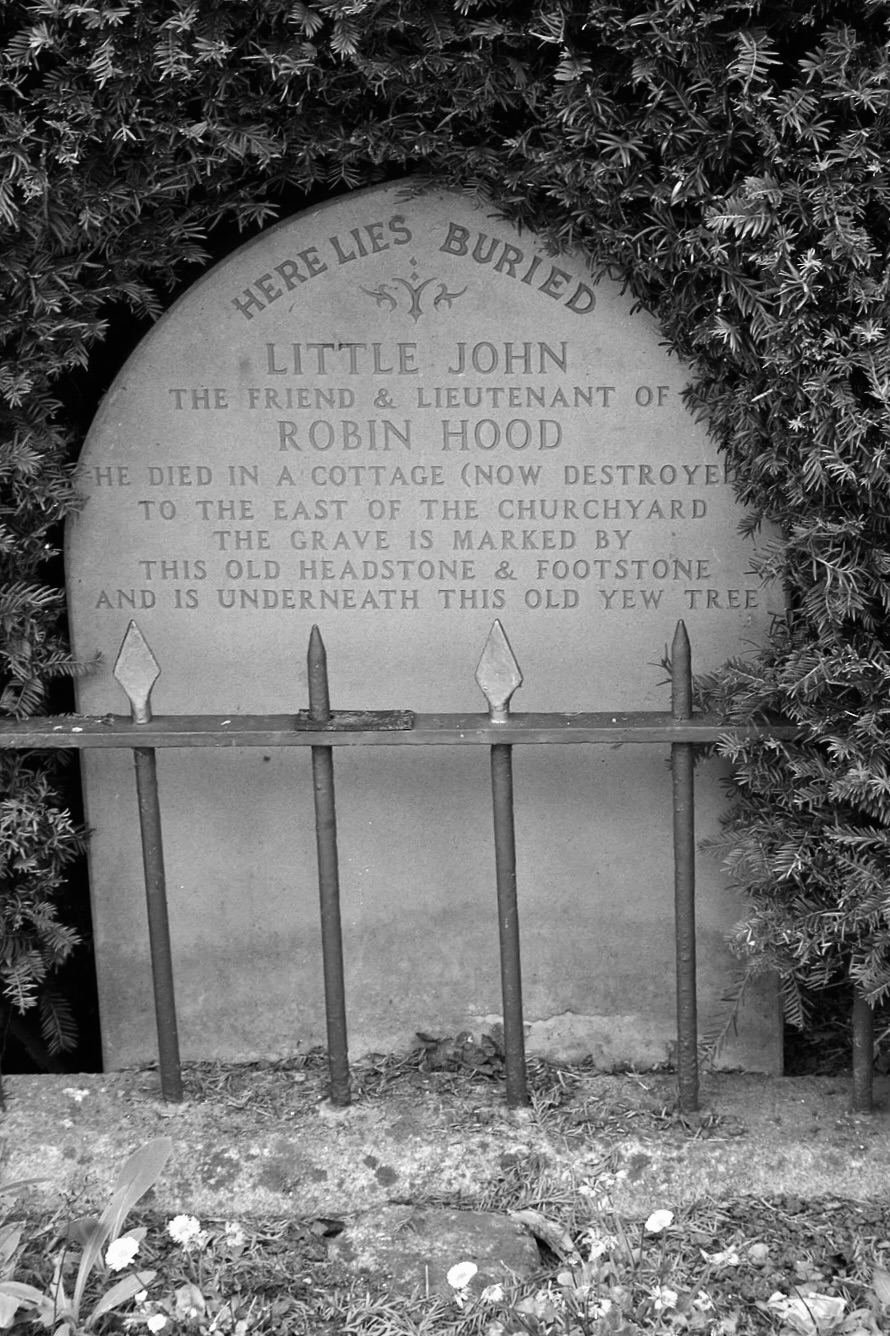
The folk record of the time suggests an excavation of the grave really did take place

The bow of Little John (from robinhoodlegend.com)