
The History of Witchcraft in Cheshire
Lecture at The Grange Theatre, May 2025
The Roman View
It's a year to the day since I was here last, talking about the history of Vale Royal, but this time it's something quite different. Tonight we're going to be talking about the history of witchcraft, here, in Cheshire.
The primary century of witchcraft association in England is the seventeenth - the 1600s - and it's one of my favourite historical periods, because it's in the seventeenth century that we have the civil war, we have the plague, and we have what has now come to be known to history as the 'Witch-Craze’.
Everybody in this room, when we talk about witchcraft and witches, will have some kind of idea that springs to mind. It could be Harry Potter or Hermione Granger, it might be Bette Midler in Hocus Pocus - or it could be a more traditional image…a hovel in the countryside perhaps? Yet the idea of what a witch is, isn't necessarily the same the world over.
In the context of tonight's talk, there are two main definitions of a witch; one who harnesses uncanny forces to influence the world around them and one who harnesses uncanny forces to do another person harm. We can split those ideas out quite easily. We can think about the healer, the wise person, ‘cunning folk’ - the belief is, of course, that they're harnessing some form of supernatural force to help people, to guide people, to find things, or use their gifts to create herbal remedies and the like.
The other, which is the one that perhaps dominates our thoughts when we think about witches, is more nefarious. It's the person who harnesses those unseen forces, those supernatural gifts, to do harm to somebody else. And that view, is the Roman view.
In ancient Rome, they blamed strange and uncanny events on people - as we'll see, elsewhere that isn't the case - and those people so blamed, in the Roman world, tended to be female. Divided into two classic tropes, we’ve got ‘the old hag’ and ‘the temptress’ - and this is the place from where virtually all our modern views of witches are born.
Elsewhere however, in places where the Roman Empire failed to reach, things are really quite different.
In Ireland, for example, they don't tend to blame uncanny events in earlier times on people, rather, they’ll blame them on fairies; there just isn't the natural assumption that a human is behind unfortunate or uncanny events that take place. Outside of the Roman world too, it's not always women. In Iceland, it's men, in Scandinavia, it's men, and pretty much anywhere north of the Rhine frontier of the Roman Empire, they wouldn't look to automatically blame uncanny events on the idea of a female witch. So I really want to cement that in our thoughts; what’s come down to us in history is the Roman concept of the witch.
So now that we know why the idea and the image of the witch presents the way it does, let's have a look at the issue of belief.
A History of Belief
For the majority of the past 2,000 years, a belief in witchcraft has been the norm. Everybody in this room, if we were to travel back in time, would have held just as firm a belief in witchcraft as they would the harvest, or the turning of the year. It was set in stone. And it's only really since the Industrial Revolution, the last 200 years, 150 years, in which that has truly changed.
So when we think about the things that we're going to be talking about in a moment, you have to try and put yourself in that space, that headspace of it being a reality - a living and breathing reality.
To that end, I want to draw your attention to this picture (above). This is not very far from here, it's Winsford, St. Chad’s Church. That’s the tower of the church and a ‘witch-mark’ that's been carved upon it. This speaks to the beliefs of the people of the time, who carved these symbols around doorways, or any kind of threshold, in the belief that it would offer a form of protection against an evil spirit or a witch who may wish to cross that threshold to enter.
If you visit almost any old building from the 1500s, 1600s, or any of your local churches, if you look hard enough, you'll often spot something similar. To understand why this came to be, we’ll need a brief general history of European witchcraft, before we discuss its place in Cheshire specifically.
Before the 1400s, the idea that there were people amongst us who could work magic, cast spells and heal people was largely tolerated by the Church, even encouraged at times. With the Catholic Church believing in miracles, it would be quite hypocritical of them to espouse that belief, whilst also ignoring the fact that magic could be commonplace in society. Magic existed, and explorations within the world of magic, within magical texts, were actually sponsored really heavily in certain sects of the Church. The Benedictines had a huge library down in Kent, full of magical texts, and in between prayer and the daily chores around the abbey, the brethren were encouraged to read and perfect anything they could, from these texts.
The idea was, that if anything nefarious was going to happen involving magic and evil, it would be better if they knew how to foresee that happening, and to try it out for themselves in a bid to try and control it. But in 1420, something changes.
A new idea takes hold in Central Europe, and this idea is that actually, magical practice isn’t something that should be going on along alongside religious society. Suddenly, magical practice is actually sponsored by God, wanting people to have their faith tested, and to do that, God would enable people to actually undertake these magical practices by the aid of ‘demons’. That belief had never existed previously, and suddenly it comes into focus, comes out of the Latin world, through Europe and then arrives in England, and therefore Cheshire, about a hundred years later, around 1520.
Around the same time, a book is published, Malleus Maleficarum by Heinrich Kramer. He’s a German priest and he's obsessed with this idea, which he adds to, and now the popular view becomes that, not only is the issue of magic and witchcraft a demonic one, but that in fact, anyone associated with it is now ripe for persecution as a heretic.
It now becomes the duty of all godly people to actively go after and persecute practitioners of witchcraft. The book and its ideas are taken up by high society. This is then followed by another book on the subject, first published in 1597 and then again upon his reaching the throne of England in 1603 - Daemonologie by King James I.
English Witchcraft
King James was a man genuinely obsessed with witchcraft. He saw witchcraft at every level of society and believed that he was a figurehead of a resistance against it. This belief had been cemented with an experience he had, sailing back from Scandinavia to Scotland. There was a storm at sea, witches are blamed for it, and he ends up personally presiding over the trials.
So, we're entering a world now where those accused of witchcraft are actively sought out, those accused of witchcraft are put on trial, and as a result, in 1604, the Witchcraft Act is passed into law; a piece of legislation that will be quoted repeatedly across the following hundred years in the prosecution of alleged witches. This leads to a situation whereby the prosecution of witches now becomes a political issue.
Because with the king so interested, suddenly, for you to become involved in the prosecution of these individuals is a real way to get ahead. It's a state-sponsored method of furthering your career. And beneath that swell of politics, at a local level, people see what's happening. They've seen that somebody's been carted off to the big house on the hill, never to be seen again. So what do people do?
They realise, that if they have a grudge with a neighbour, or a family feud going back years, well, now if they point a finger convincingly enough and accuse them of being a witch, they can cause all kinds of trouble. And so, a social pandemic is born, and we arrive at the point in time, come the early 1600s, where the English Witch-Craze is born. And it is mostly an English phenomenon, right the way through society. Yes, it's been born in Europe, and some people here tonight may be familiar with the things that were happening in German and elsewhere, but that is a very different situation.
Across what we today call the British Isles, it is a very English phenomenon in this period. In the highlands of Scotland, they don't have any witch trials, it's only in the lowlands, where there's English settlers, that we find any trials. In Wales, too, unless it's in long-standing English communities, they're not trying witches. In Ireland, they're generally not trying witches, and the only time it comes into focus, again, is if there's an Englishman at the root of the event.
Generally, anywhere that is predominately Gaelic or Celtic in culture, well you just won't find witch trials or motivations of wanting to hunt witches within the community. So, who's being targeted in England? Broadly, this is broken down into three categories, that we've touched on before.
Number one, people within communities that are genuinely believed to be practicing the dark arts. Number two, people on the wrong side of those who will throw accusations of witchcraft out as a way of settling scores and grudges, and then number three, people who are marked out as outcasts of society, providing easy targets for those witch-finders trying to make a name for themselves in order to further their careers.
Accusations ranged from murder by the making of clay dolls to the bewitching of a neighbour's cow when the milk has gone sour. And then you've got all of your ‘cavorting the devil at midnight’ stuff too.
It's a real mix, but it doesn't matter what you're accused of, the outcome could be just the same. In total, around five hundred alleged witches across England were brought to trial and executed. And in Cheshire, this was carried out at Chester, where we had thirty four trials and eight hangings, the peak being a 10-year period from the end of the 1640s up to 1659.
Witchcraft In Cheshire
Before we get to the actual witches, there's a couple of people that we have to mention, just because of what bizarre and incredible lives they had, connected to the time, and to show the level and the depth of this subject, permeating through the local culture.
John Bradshaw was born near Stockport in 1602. He was a lawyer, a major political figure, Chief Justice of Cheshire, and he was most famous, I think, to history, for being one of the signatories of King Charles I's death warrant. It is he that sits in judgement for most of the trials carries out at Chester in the period. He had a very gruesome end though. After the restoration of the monarchy in 1660, as you may be aware, there was this bizarre situation that developed where the people who signed the death warrant of King Charles I, if already dead, were then dug up, and their remains hanged; and he was one of them.
Then there’s Thomas Cooper. He came to be vicar in the village of Great Budworth, here in Cheshire, at the end of the 1500s, so just as that fever for witchcraft was starting to catch fire, and whilst there, he creates a diary. He's already interested in witchcraft, but he starts a diary because it would seem the level of activity - or perceived activity - of witches around Northwich and Great Budworth is simply astonishing. He comments that he's ‘constantly at the buffering of Satan in his deadly chores’. He does battle with a ‘confederacy of witches’ in Northwich; and plays witness to an event concerning ‘the boy of Northwich’ who was apparently ’possessed by demons'. Such an impression on Cooper do these events make, that when he leaves Cheshire around 1610, an eventually settles in London, he campaigns for the establishment of a Royal Society to be set up in study of witchcraft.
Now, the witches, those people from society who were accused of various acts of witchcraft, they would all follow pretty much the same path. First, they would be brought before a local justice, and then, they’d end up in Chester. And when they were in Chester, largely at the Northgate prison, they would then be transferred to trial at the Court of Common Pleas in St. Werburgh Street - which is now, I believe, a Superdrug store - and from there, executions would take place on Gallows Hill in Broughton.
That is a very strange place historically, I can understand an area of your town, your city, being the designated place for execution. That happened everywhere. But what we actually have on Gallows Hill is a kind of theme park of the macabre. You've got the gallows, you've got four sets of stocks, a standing pitch-pyre for burning, and at times there would be crowds of 20,000 people turning out for a full day's spectacle of death. Incredible really. From there, the bodies would be taken down and they'd typically be buried in a castle ditch just outside the graveyard of St. Mary on the Hill.
On the screen here, are the witches executed at Chester.
Sibil Mercer from Acton, 1631, bewitching cows. Elen and Elizabeth Stubbs and Anne Stanley, Chelford, 1654, murder. Anne Thornton from Eton, for perpetrating ‘wicked acts’ and keeping ‘three imps in the likeness of animals’. Mary Baguley from Wildboarclough, she's really late on, 1675. Mary was arrested by the parish constables for the murder of Robert Hall, who she'd visited several times in the days before his death. Mary was a healer - a herbalist - and the problem was, she admitted that she’d tried to treat him for his ailments, but when they got an ‘expert' in to ask her what was in this tincture that she'd made, what was this ointment, they used different names than Mary did. Same plants, different names, and so it was obvious Mary was a witch. On the 16th of October, she was convicted and the following morning she was hanged.
Now, each of these cases has got a long litany of detail, impossible for us to cover tonight, so we're going to zone in on one case in particular, and I think it is perhaps the best case of the lot to really, to show just how these things played out.
The Rainow Witches
There on screen you've got the memorial stone, that's there to this very day in the village, and it's quite the tale. At the autumn Assize Court in 1656, three witches were brought to trial in Chester. Anne Thornton from Eton, who we mentioned previously, and two women from Rainow; Ellen Beech and Anne Osboston.
The following accounts of their actions are taken from the court testimony of September 1656, a session in which they were both convicted and then hanged on October the 8th, being buried in the castle ditch the next morning.
‘Alan, wife of John Beech, late of Rainow in Cheshire, Collier, on the 12th of September 1651, and on diverse other days as well, before as after at Rainow, did exercise and practice the invocation and conjuration of evil and wicked spirits with which she consulted, entertained and rewarded. On the said 12th of September, Ellen Beech did exercise certain witchcrafts upon Elizabeth Cowper, late of Rainow, spinster, whereby she, from the 12th day to the 20th of September, did languish and then die.’
Regarding Anne Osboston, Ellen’s neighbour, her account states a considerable number of charges relating to her involvement with witchcraft; including how she had apparently practiced ‘certain wicked and devilish acts upon John Steenson, husbandman, which caused his death on the 20th of November.’ Then on the 30th of November, she is accused of using ‘enchantments upon Anthony Booth of Macclesfield, a gentleman, causing his death on April the 1st following year.’
Two more entries are mentioned for Anne. That a Barbara Potts was cursed on the 20th of November 1651, dying on the 20th of January the following year and that four years later, much closer to the time of the apprehension, a yeoman of Rainow too died following an encounter with her. Clearly, she was not the most popular woman in Cheshire during the 1650s.
But as the 1600s wore on, the idea of these witch hunts and witch trials become less and less fashionable. They still happened, but they weren't prosecuted with the same kind of rigour and zeal as they had been before. And come the 1680s, we had a major political event, with the Glorious Revolution, and William of Orange coming onto the scene; and by then, the more magical aspects of legal discourse became somewhat curtailed. And so it was that in 1685, the last person in England would be hanged for witchcraft; Alice Molland, down in Exeter.
The Obsession Ends
There would be other characters that pop up in the Cheshire records to do with witchcraft. One of the most popular is Bridget Bostock, a woman who became known as the ‘Cheshire Doctress’ during the 1700s. She was a healer. She was never really accused of anything nefarious because, again, the world was changing. She actually became so famous for her ability to cure all manner of ills that around 500 people a day were said to have travelled to her home asking for help; a situation that was impossible to manage and so she was forced to retire. She's remembered to us today as a so-called ‘white-witch’. A hundred years earlier however, things would have been very different for her.
From Bostock's time through to the end of the 18th century, we pass through the Industrial Revolution, and absolutely everything changes. All of those rural communities, they're now resettled and brought into the cities, the new urban centres that are developing, and we see a big exchange of folklore.
That's the point in time whereby a legend that had been doing the rounds, say here in Hartford for 500 years, might now spring up anew north of Manchester. But through that process, well, people just aren't so concerned about witchcraft anymore. Frankly, they’re more worried about working conditions.
When we talk about witches today, we've lots of areas that breaks down into. We’ve got the Wiccans, Wicca being a 20th-century reinterpretation - or invention - of magical practice related to historical perceptions. Then we have the cult of the earth goddess, all the wonderful ‘new age’ stuff, crystals and the like. Then we have the media, as we mentioned before, Harry Potter being the most obvious example. And we have Druidism, which came out of the Victorian period, again, a bit like Wicca.
But my point is, no matter the world around us, people will always break into groups and find something of interest in that same wheelhouse as the magical thinking that has inspired us for thousands of years, in every age.
That's what I find fascinating by the modern view of witchcraft in its various guises. When you peel back the way it's dressed up, and you peel back the ceremony and the ideas, the TV shows, the books…it’s all coming back to that central place, and that idea, that people have always had a belief in magic.
We, have always held a belief in witchcraft.
Thank you very much.
Eli Lewis-Lycett 2025
Sources and Further Reading
Regarding Roman stereotypes;
- Kors, Alan Charles, and Edward Peters (eds.). Witchcraft in Europe, 400–1700: A Documentary History. 2nd ed. Philadelphia: University of Pennsylvania Press, 2001.
- Levack, Brian P. The Witch-Hunt in Early Modern Europe. 4th ed. London: Routledge, 2016.
- Russell, Jeffrey Burton. The Prince of Darkness: Radical Evil and the Power of Good in History. Ithaca, NY: Cornell University Press, 1988.
Regarding medieval and early modern witchcraft beliefs;
- Thomas, Keith. Religion and the Decline of Magic. London: Weidenfeld & Nicolson, 1971.
- Sharpe, James. Instruments of Darkness: Witchcraft in Early Modern England. London: Hamish Hamilton, 1996.
- Macfarlane, Alan. Witchcraft in Tudor and Stuart England. London: Routledge, 1970.
- Briggs, Robin. Witches and Neighbours: The Social and Cultural Context of European Witchcraft. London: HarperCollins, 1996.
Regarding cunning folk, healing and popular magic;
- Davies, Owen. Popular Magic: Cunning-folk in English History. London: Hambledon Continuum, 2003.
- Davies, Owen. Grimoires: A History of Magic Books. Oxford: Oxford University Press, 2009.
Regarding Cheshire witchcraft and the Chester trials;
- The National Archives. Chester Assize Court Records, seventeenth century.
- Cheshire Archives and Local Studies. Chester Quarter Sessions and Assize Records.
- Poole, Robert (ed.). The Lancashire Witches: Histories and Stories. Manchester: Manchester University Press, 2002.
- Cooper, Thomas. The Mystery of Witchcraft. London, 1617.
- Notestein, Wallace (ed.). The Journal of Thomas Cooper, Rector of Great Budworth. Chetham Society, 1953.
- Keeble, N. H. The Black Bartholomew's Day Preachers. London: Duckworth, 1978.
- Wedgwood, C. V. The King's Peace, 1637–1641. London: Collins, 1955.
A variety of online resources are also used including British History Online, Historic England, various genealogy databases and folklore collections. For any further specifics, please contact the author directly.
The English Witch-Craze of the 17th century was a remarkable and dangerous time in Cheshire history. This feature presents an edited transcript of a lecture given on May 15th, 2025, at The Grange Theatre, Hartford, Cheshire in conjunction with Northwich & District Heritage Society, entitled The History of Witchcraft In Cheshire.
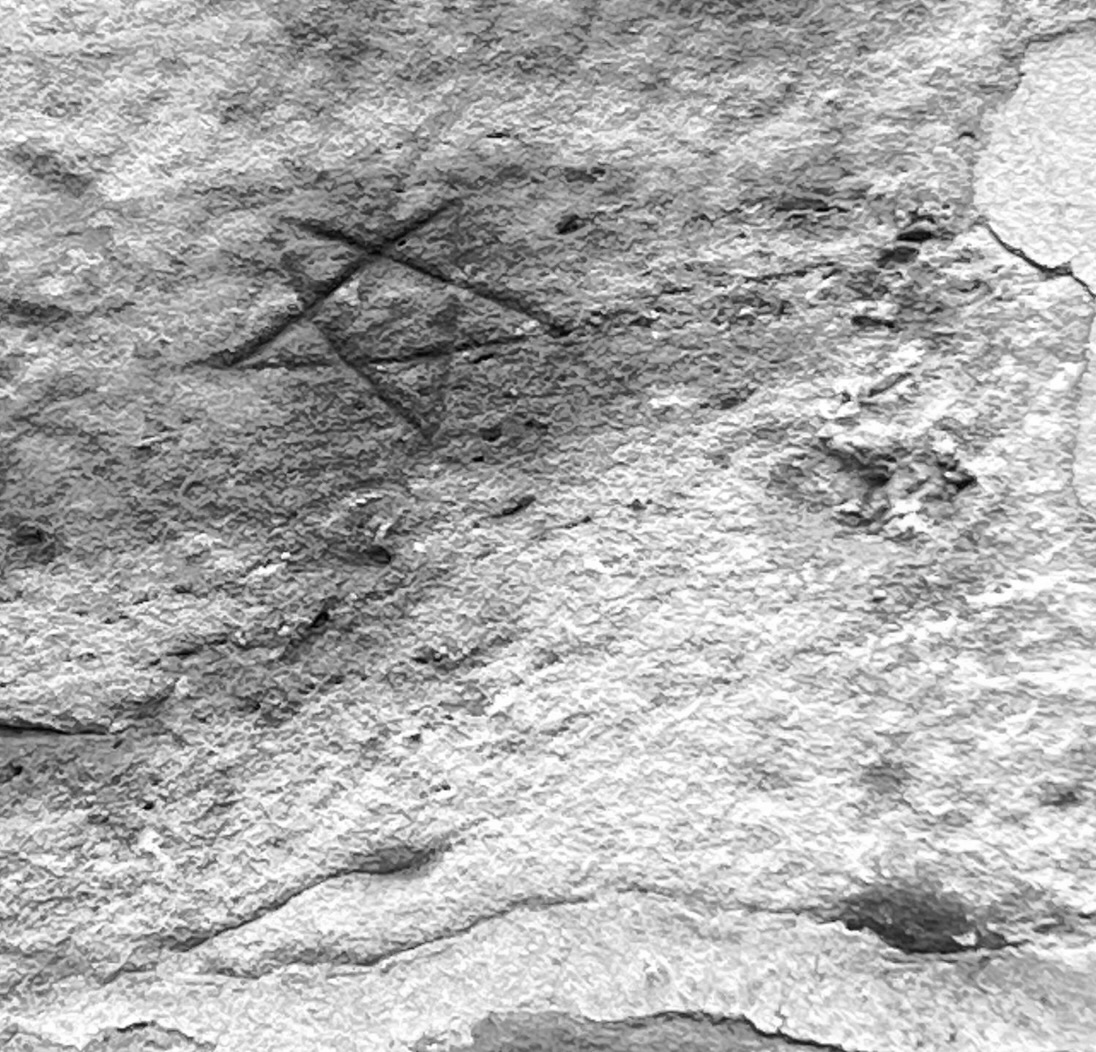
A witch-mark referenced in the lecture, St. Chad's, Over.
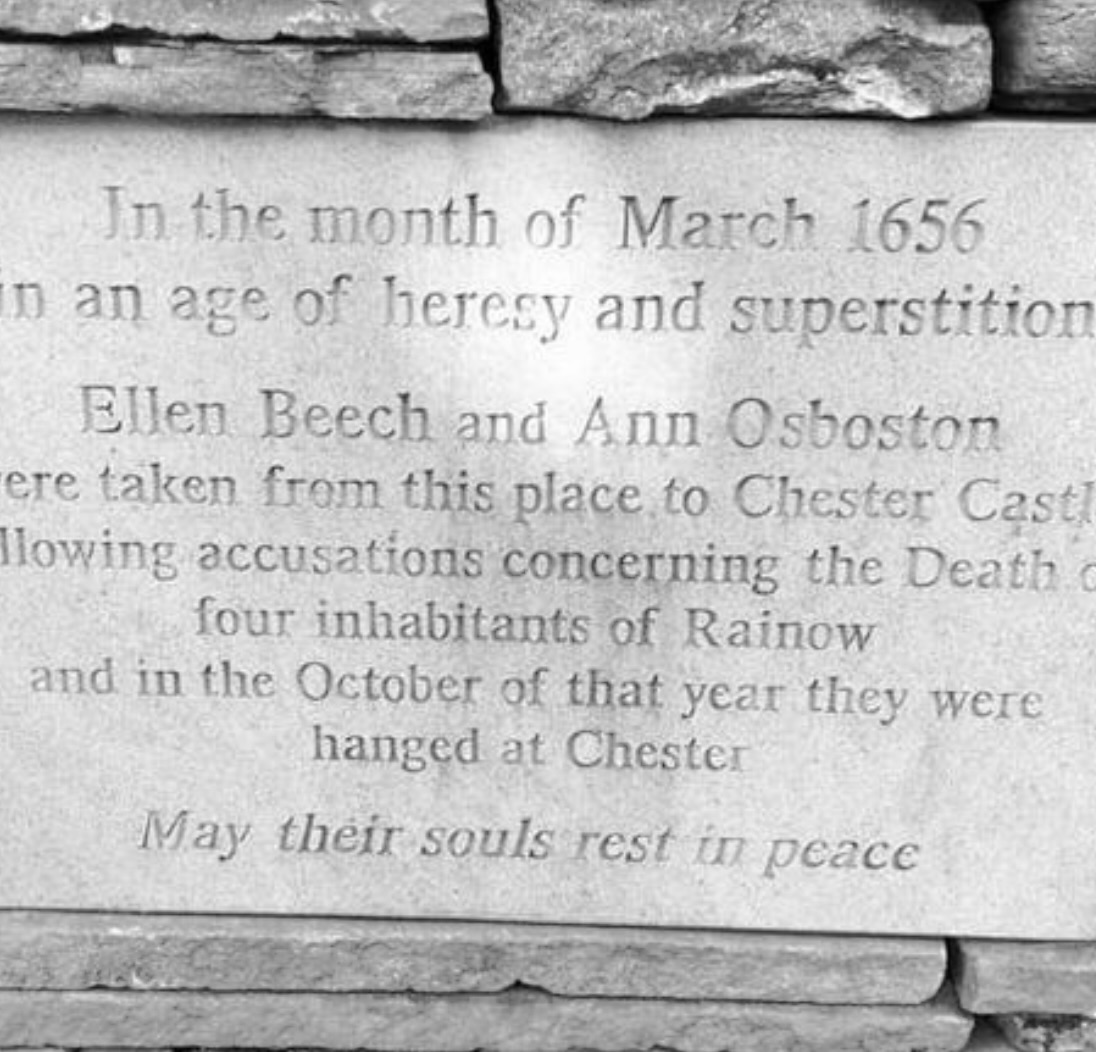
The memorial stone to the Rainow ‘Witches’
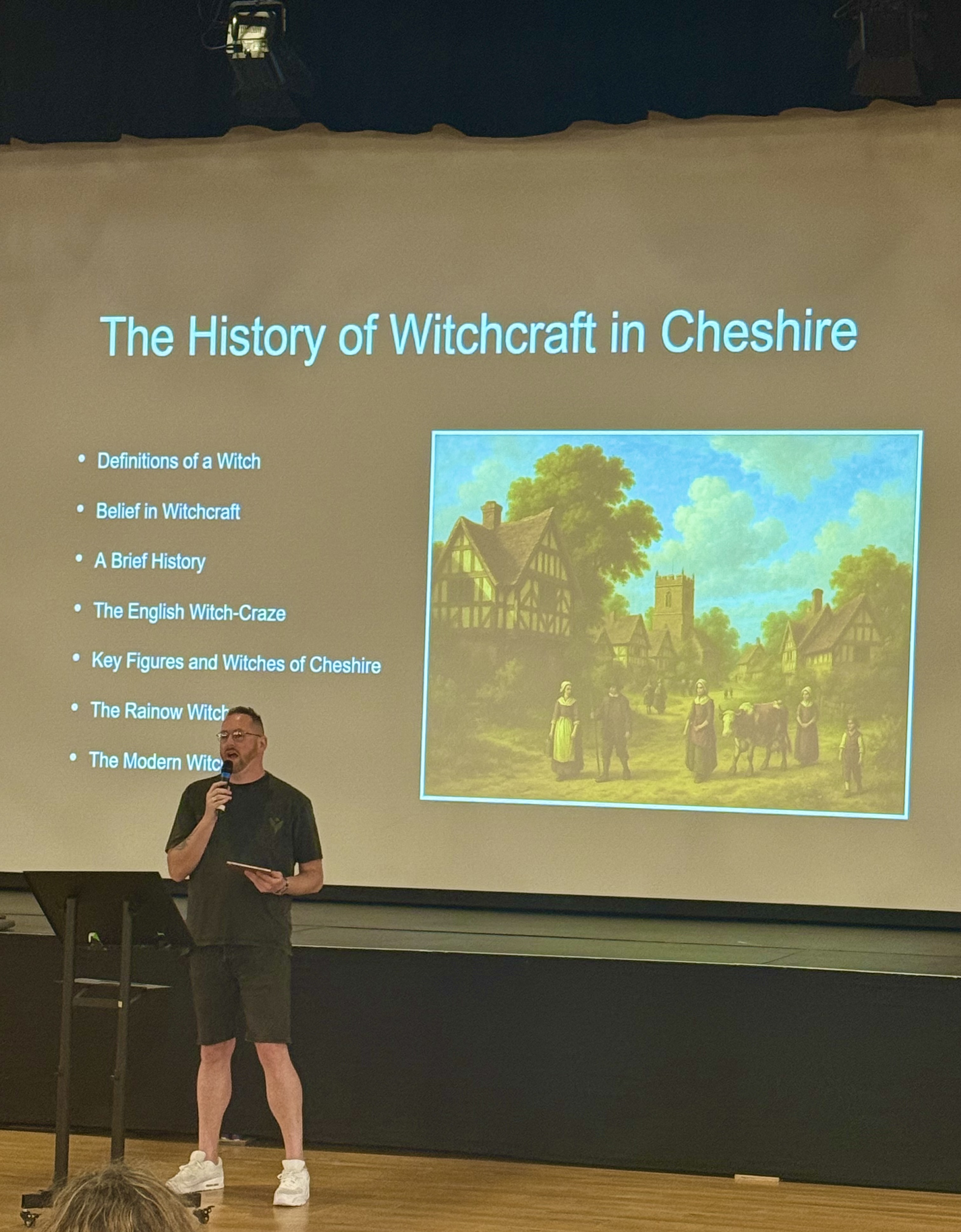
The talk at The Grange Theatre, 2025