
God Bless the Brine
The Folklore of Cheshire's Historic Ballads
Introduction
During the nineteenth century, something extraordinary happened to the folklore of Britain. Following the migration of rural populations into new industrial boom towns, for the first time in history, people from relatively distant settlements came together in a permanent manner. This meant that their folklore and legends - tales that had been anchored in their local communities for centuries - were now being heard by fresh ears. As these old stories and superstitions reached new audiences, they found their way into the fascinations of the landed classes; people with the time and money to indulge their interest in all things antiquarian. Combined with the winsome, and often earnest, longing for the past that was so in vogue due to the Romantic arts movement of the time, a new, passionate pastime was born. These stories, it was decided, needed to be preserved before the communities that bore them became so dispersed among the new towns and cities that their inherent oral histories - effectively the folklore of the nation - faded from memory.
There had been books on lore and legend before, but they tended to cover far broader themes, and were, for the most part, the preserve of a small group of scholars and clergymen. This new pastime was something quite different. Across the British Isles, inspired individuals began to reverently collect and record the tales that they were hearing. In turn, enthusiasts in even the remotest parts took up a similar quest. Often, this meant travelling out across the countryside, speaking with locals, writing down their recollections and retellings and then, of course, publishing their findings in great leather-bound books, for an affluent audience whose thirst for these ‘popular antiquities’ was seemingly inexhaustible. It is no exaggeration to say that without this era of documentary antiquarianism, we would have a far, far thinner record of the folklore of Britain today; and in some regions, we would have next to nothing. As a folklorist involved with various projects, it has been my privilege to read a lot of these books. In doing so, I have found that amongst the dozens upon dozens of titles published during this golden age of antiquarian writing, original work recording the folklore of my home county of Cheshire is comparatively lacking.
This is due in large part to the particular circumstances of the Industrial Revolution within the county itself. Macclesfield grew substantially thanks to the boom of the silk industry, and Crewe was transformed from a village into a bustling railway town. The salt-producing towns of Cheshire found an increased demand too, but their workforce was predominantly drawn from the pre-existing local population. There just wasn’t anything like the magnetic, dynamic shift of population that we find elsewhere in the Northwest. Liverpool and Manchester became two of the most industrialised cities in the world during the era. The city of Chester, meanwhile, avoided any large-scale industrialisation. This meant that, from the outset, Cheshire experienced far less intermingling of oral tradition than its neighbours. It simply drew less attention. Yet before too long, some local landed folk caught the bug for folklore collection all the same, and so, today, we do have a handful of titles available. However, these tend to lack the kind of direct, narrative accounting so valued from the period. One among them, however, is different, and is distinct in style; its manner of collection being that of the historical ballads and rhymes sung and recounted throughout Cheshire during the mid-1800s.
Born at West Hall, High Legh in 1815, Egerton Leigh came from an ancient Cheshire family. Educated at Eaton, he rose to become a major in the Cheshire Militia and would, in later life, serve as both High Sheriff of Cheshire and as an MP. His collection Ballads and Legends of Cheshire, published in 1867 by Longmans & Co. makes for the earliest formal gathering of local folklore we have for the county. The difficulty with this collection, however, lies in its format. Presented mostly as rhyming lyric sheets and songs, it may be historically invaluable, but it is not particularly accessible to the modern reader, myself included. The wonderful irony of this is that in recording the folklore of Cheshire in such a manner - ballads and rhymes being the oldest form of all - it may well be that Leigh’s collection is actually one of the best preserved oral collections of the age.
These rhymes would have been received from local storytellers at inns and from workers in the fields. They offer real antiquity too, with several likely originating before the seventeenth century, for they occasionally reference historical events so distant, there would have been no way for the rural working classes of the 1860s to have known about them other than by way of the generational pass-down of oral history. A few tales from this collection remain well known to local enthusiasts to this very day, elsewhere, however, we find stories that may well be finding themselves presented here in traditional narrative form for the very first time.
To this end, I have transposed the most vital and defining entries from Ballads & Legends of Cheshire, shifting them from the somewhat charmingly redundant form of lyrical rhyming verse toward something closer to traditional folktale. I have altered nothing in terms of content or detail, but studied the rhythmic text of the original structure and, if anything, debased it to its crudest form, which I have then presented in the style of the more prose-based collections of the time. In doing so, I have found that the old tales within the ballads reveal themselves with relative ease. Old tales which, obscured and hidden within their rhyming couplets for 160 years or more, may now form a collection that is genuinely indicative of the earliest Cheshire folklore.
The Miracle of Constable Sands
Long ago, following the Norman Conquest, there lived Earl Richard, the second Earl of Chester and son of Hugh Lupus. He was known as a devout man, ever seeking to do what was right. In those days, a deep longing stirred in his heart to visit Saint Winifred’s holy well, and so he set out as a humble pilgrim toward Holywell, hoping to find spiritual favour and blessing. Word of the Earl’s journey had traveled into the Welsh mountains, and when the wild Welshmen heard he was passing their way, they gathered secretly. They bowed low in feigned humility, yet inwardly they rejoiced, for they had laid a trap. They swept down from the heights, fierce in their purpose, and set themselves upon the king’s highway between the Earl and the city of Chester, meaning either to seize him or to take his life.
The Earl’s son soon perceived the danger and sent a swift, hidden message to Chester. It was addressed to his constable, William, commanding him in both duty and affection to raise a great army and hurry to Basingwerk. Only by such speed might the Earl be delivered from death or captivity at the hands of the Welsh. William the Constable did not delay. He summoned a mighty host and arrayed them as best he could, then led them toward Hilbre, trusting they would find ships there to carry them over the water.
Back then, Hilbre was a royal landing place, full of vessels coming and going. But when William and his men reached the shore, not a single ship remained to carry them across in time to save their lord. Then sorrow fell upon the army. Moved by love for their Earl and the peril he faced, many wept aloud. Some sighed and sobbed; others were so overcome with grief that they wandered as though robbed of reason.
In that hour William the Constable, burdened more heavily than any man, called for a contemplative monk who dwelt nearby. He begged the monk for counsel and for holy prayers. The monk advised him to kneel and humbly entreat Saint Werburgh, their own patroness, for help in this desperate need. So William knelt at once and prayed;
‘O blessed Werburgh, pure virgin, I beseech thee, help me this day, that we may cross this river safely and surely, and so deliver my lord from ruin. And here I promise, before God and thee alone, to offer a gift upon my return home.’
When his prayer ended - still wet with tears and heavy with anguish - a miracle was granted. The goodness of the Saviour shone forth. As once the Red Sea parted for Moses, and the River Jordan obeyed Joshua, so now the deep waters of the River Dee drew back. Before the eyes of the constable and all his company, the sands of the riverbed lay bare and passable. At the sight of this wonder, which no power of nature could explain, William and his host lifted their voices in praise to Almighty God and in blessing to Saint Werburgh. Then they crossed the Dee upon the sure, dry sands, and went on into Wales, rescued their lord from fear of his foes, and brought him safely home to the city of Chester.
Afterward, William the Constable came to the monastery to give thanks to Saint Werburgh, humbly fulfilling the vow he had made in his hour of peril. He offered to the house the village of Newton, and in time he founded the Abbey of Norton as well. And the place where the army crossed the river - the wide strip of sand revealed by miracle - has been known ever since as Constable Sands.
The Tale of the Nutwoman
In the town of Knutsford, where some say King Cnut once dipped his royal foot, there lived an old woman who earned her living by selling nuts. She was so familiar to all the townsfolk that wherever she went, pennies seemed to fall into her hand as if they rained upon her. When her time came and she died, her will revealed a curious wish. She desired that her head be laid in the grave upon a sack filled with nuts. Her neighbours laughed at this strange request, yet it was faithfully carried out. So it was, that when she was buried, her pillow was a bag of nuts. She had not lain long beneath the earth before she found that the nuts were no comfort at all.
They made her resting place uneven on every side, and she could find no ease. At last, driven to desperation, she gave a mighty leap one starry night and sprang out of her grave, dragging her sack of nuts after her. She seated herself upon a tombstone and cracked every nut she had, some with her teeth, some with her foot. When all were done, she slipped back down into her coffin. Before settling herself, she folded her sack neatly, but first gave it a hard shake to rid it of any nuts that might remain. Then she placed it beneath her head as a smooth pillow. She had cracked all but one nut. When she shook out the sack, that last nut bounded away and dropped into a small hole near her grave. And so the tale of the old nut-crone ends. The story, they say, must be true, for a tall nut-tree grew from that very spot.
God Bless the Brine
In an old Cheshire village there stood the brine pits, and of them all, none was more famed than the one called Old Biot Pit. For as long as anyone could remember, a custom had been kept there on Ascension Day. When that morning came each year, the children of the village gathered to honour the brine that sustained their lives. They came carrying wreaths of many colours, flowers of early spring bound together by small, eager hands. Lent lilies they brought, and bunches of sweet nancy. They added the silver-white ladies’ smock and the bright marsh marigold, all chosen in the delight of childhood.
Holding their garlands high, the children formed a ring around Old Biot Pit and lifted their voices in the song, God Bless the Brine. Ribbons were fastened around the pit, and green branches freshly torn from the groves were set in place. The villagers, young and old alike, put on their holiday dress and joined in lively dances. Music filled the air; the loud timbrel ringing, the drum beating its steady call, and even the clarion lending its voice. All were reminded that the fields and plains would give no flavour to their food were it not for the salt drawn from these brine pits. Salt, the people often said, was a pledge of true friendship. Thus they honoured not only the usefulness of brine, but also its ancient ties to loyalty and trust.
The villagers did not envy distant lands where, it was said, rivers flowed over sands of gold. Their pride was in the brine pits themselves, which they believed were treasure enough. Ascension Day remained their holiday of feasting, singing, and play. They remembered, too, that long before Roman hosts had marched through Cheshire in their pomp of war, their own forebears had laboured at this very pit, drawing forth the hidden wealth of the earth.
Tales were told of far-off countries where herds wandered salt-sick, and where the riches of sea and mountain were useless without it. Who, they asked, could measure the worth of this heavenly treasure? And so, year after year, on the morning of the Ascension, the people of Hellath Wen gathered again. As their Saviour had risen on that day, so their thanks rose upward. They brought their wreaths of colour, joined hands in a great circling ring, and once more sang around Old Biot Pit, God Bless the Brine.
The Skeleton Hand
In the village of Lymm - famous far and wide for its fine hay - there once lived an old crone of curious habits. She had no liking for plain drinking water; if she drank anything clear, it was clear brandy, not the simple water of the brook. Yet, strangely enough, when she needed water for washing her clothes, she flatly refused to take it from the stream in the vale. Instead, she always went to fill her pail at the old church spout. Her neighbours scolded her often, insisting it was wrong to draw water from the church when the brook ran free below. But the old woman paid no heed. ‘Soft water is best’, she declared again and again, and claimed she had proved it enough times to know. One stormy day, when the wind moaned wildly and the rain fell in sheets, lightning tore across the sky, and thunder rolled like cannon fire, she set out once more to fetch her pail of water from the church spout.
The gargoyles on the tower gnashed their stone teeth as the tempest raged, and the old crone trembled as she neared the place where, so people said, she committed a small act of sacrilege. Still, she placed her pail beneath the jutting spout. Then suddenly she shrieked. From the mouth of the spout, a skeleton hand shot forth. In an instant it struck her, knocking her backward as it clutched the pail.
As she lay on her back, half-stunned by the blow, she watched in horror as the bony hand and the pail slid upward into the thin lead pipe and vanished within the tower. Though the pipe was narrow, the pail was neither crushed nor bent. Neither hand nor pail was ever seen again by mortal eyes. Later the villagers found her lying helpless near the tower. Some said she had been struck by lightning. Others blamed the brandy. They carried her home, and from that day onward she never tried again to fetch water from the church spout.
The Lady’s Shelf
Where the River Dee meets the wide sea lies a small islet called Hilbre. Its shores feel both fresh and salted waters, and on its rocky edge is a cave, bright with clusters of little pink blossoms that the children call Lady Cushions. Behind the cave runs a narrow, wind-lashed ledge known as the Lady’s Shelf. In summer, young men and maidens wander there to talk, laugh, and rest in the coolness of the grotto. Few pause to recall the old legend that a monk once prayed in that cave, or that the Shelf itself was the place where the waves once laid the body of a maiden.
Long ago, when monks dwelt on Hilbre, keeping watch over the shrine of St. Hildeburgh, among them was a Benedictine who had carved the cave with his own hands, seeking solitude there in order to resist temptation and to contemplate the sea. One evening, as he went to his retreat, he was startled by the sight of a young woman lying upon the Lady’s Shelf. She was deathly pale, marked with blood, richly dressed though drenched and stained by the sea. Jewels gleamed, braided among her jet-black hair. Alarmed, the monk ran to summon help, but a faint voice called him back. The maiden begged him not to leave, for she felt death near. She wished to confess before her strength failed.
She said her name was Gertrude, only daughter of the Lord of Shotwick. Her mother had died giving her birth, and she had been raised with her father’s orphaned page, Edgar. Edgar had ever been at her side, anticipating her wishes and guarding her from dangers. More than once he had saved her life, drawing her from drowning, driving off robbers and carrying her from a burning tower in the dead of night. Skilled in hunting, in war, in tale, song, and music, he pleased her heart in ways she scarcely understood. In quietness their affection deepened. They had never spoken of love, yet it settled upon them softly, like down on a dove’s breast. But peace did not remain. A wealthy Welsh knight, renowned in the region, sought her hand. Her father, eager to see her wed to rank and riches, agreed at once. The knight came to her, declaring her fate, and she turned deathly pale. Soon her father learned that her heart belonged to Edgar, and he grew furious, unable to bend her will.
One morning he summoned her to dress in her finest, saying they would visit an old friend across the water. She obeyed, unaware of his purpose. Their small boat sped swiftly over the waves beneath the bright sun. Nearing the Point of Ayr, her father revealed the truth - she was being taken to marry the Welsh knight that very evening. And to break her resistance entirely, he told her a cruel falsehood; that Edgar was dead, drowned in the sea.
At this Gertrude collapsed upon the deck, her senses leaving her. In a dreamlike fog she felt the boat heave beneath a great surge. She thought she heard her father crying out in terror, begging the sea to spare her, vowing Edgar still lived, pleading that he would be welcomed as a son if only she survived. After that she remembered nothing until she awoke in the monk’s cave on Hilbree, her body chilled and battered by the waves. As she felt her life slipping away, she told the monk to strip the bridal jewels from her and prepare her for burial.
She asked that Edgar be told she had been sorely tried, and tried to speak further, but death overtook her before she could finish. From that time onward no monk ever used the Lady’s Cave for prayer again. Still the pink flowers bloom as they always did, and the mingling waters of the Dee and the sea still wash the isle each day. But the shrine of St. Hildeburgh lies long silent, its guardians gone, and the lonely rocky shelf where the waves bore Gertrude’s body remains a quiet remembrance of this tragic tale.
The Devil and the Friar
In the high time of Vale Royal, when the abbey was full of monks and the Cheshire countryside lay quiet beneath the moon, there lived a certain Friar Francis, well known for his fondness for venison pie and strong ale. One clear night, as the brethren slept and moonlight shone over the vale of Delamere, Friar Francis was visited in his dreams by the Devil himself. The Devil, ever cunning in the hunt for souls, tempted him with visions of overflowing jugs of ale and platters piled high with venison.
These delights, he promised, would be the friar’s in endless abundance, if only he would sign a certain document. The Devil unrolled a parchment glowing with letters of fire. Written in old black-letter script, it proved to be the friar’s last will and testament. Its meaning was plain and perilous;
‘I give and bequeath all the goods that I have to those who shall carry my corpse to the grave, and this I now grant for the deed they shall do, my soul to the under-signed willingly goes too.’
It was a contract, trading his soul for worldly pleasure.
‘Agreed’ said the friar.
‘Agreed’ cackled the Devil.
Friar Francis pressed his thumb upon the sealing wafer, and the Devil signed with his claw. The pact was made. Yet the friar was not finished. With a glint in his eye, he announced that before the Devil could claim him, he must grant three wishes. The Devil demanded to hear them.
‘First’ said the friar, ‘I require good buck venison, enough for the greatest appetite.’
‘Done’ said the Devil.
‘Second, I ask for hogsheads of ale, without limit.’
‘Done again’ said the Devil, growing impatient. ‘Now the third?’
The friar pointed toward the wide, barren stretch of Merton Sands, lying between the Mersey and the Dee.
‘My third request is most simple of all. Weave me a dozen hay-bands, twisted from the grass that grows on Merton Sands.’
The Devil looked at the barren sands and baffled, flew off to begin the task. He searched by moonlight. He searched at dawn. He searched through the heat of noon, from Mersey to Dee. But nowhere on Merton Sands did he find even a single blade of grass with which to twist a hay-band. The sands were bare and empty. He had been tricked.
Unable to complete the third condition, the Devil lost all claim to Friar Francis’s soul. The friar feasted richly on venison and ale, while the Devil raged helplessly. From that day onward, the Abbot of Vale Royal declared that never again would he or any of his monks strike a bargain with the Devil. And the people of Cheshire kept watch to ensure Merton Sands stayed bare of grass, lest the Devil return to finish his task and claim what he had lost.
A Legend of Combermere
Long ago, when sunlight gleamed upon the clear waters of Combermere, a group of servants from the nearby estate gathered on the shore. Deep beneath the surface, the ancient bells of the old monastic house were believed to lie, and on this day the men had come to raise them. As they prepared their ropes and gear, a strange, chilling sound rose from the water. It was a voice, unearthly and resonant, speaking from the depths. The men froze as the spirit-voice issued its warning. Any attempt to raise the bells, it declared, must be made without a single unholy word. Should any man utter a profane oath, the bells would sink back forever into the lake’s dark bed and the offender would drown, his body never to be found again. The voice promised that the smiling shore would never smile for him until the last trumpet of doom.
Frightened but resolute, the men continued. At last they managed to bring a great bell to the shore and ease it onto the land. All seemed well. But one man, flushed with triumph, laid his hand upon the rim and boasted aloud. Forgetting the warning, he swore, calling upon the fiends of hell that the bell would not slip back into the water, no matter the force. The oath had scarcely left his lips when the ground beneath them gave way. The earth crumbled, the waters surged, and the heavy bell slid back into the mere, dragging the man with it. Both vanished into the depths.
The others searched the lake far and wide, but the man’s body was never recovered. To this day, the people around Combermere tell of how one of their forefathers drowned with the sacred bell by defying the spirit’s command. The tale endures from parent to child, of the holy bell lying hidden beneath the waters, and of the man whose impious scorn sealed its fate together with his own.
The Legend of Over Church
Long ago, tradition says, the church of Over did not stand in the lonely place it occupies today. In ancient times it stood in the very heart of the town, close to the people, where on every Sabbath, fast, and holy day, the townsfolk gathered to receive spiritual nourishment. But Satan had long resented its presence. Again and again his snares were broken, his schemes undone, his toll of souls denied by the church’s holy protection. His black heart seethed with fury, and he brooded darkly over every infernal art he might use to avenge himself. At last, one morning at break of day, the Devil rushed upon the church in violent wrath.
Digging in his claws, he tore the entire structure from the earth and lifted it high. Bearing it upon his impious wings, he flew off, shrieking in triumph, certain that no eye had seen his deed - least of all the monks who had battled him since his fall from heaven. But the monks had indeed witnessed him. Straightaway they raised their voices in holy chorus, filling the air with prayers and solemn anathemas. Their cries rose, calling upon heaven to halt the robber’s flight and shield the sacred building. Still the Devil flew, though the burden grew heavier with every moment. His determination hardened, until a new sound rolled across the sky, striking terror through him.
From the direction of a distant tower - believed to be the great abbey church of Vale Royal - a loud, crashing peal of bells broke forth. Stunned by the ringing bells and shaken by the monks’ prayers, the Devil faltered in mid-flight. His strength gave way. He could no longer bear the church’s weight and it slipped from his grasp and began to fall. In rage he kicked at the tumbling building, but a dark mist wrapped itself around the church, guarding it from ruin.
With a scream of despair, the Devil fled into the murky air, his plot utterly defeated. Meanwhile, the monks and their abbot cast themselves upon the ground in prayer, knowing that only heaven could save the church from shattering upon the earth. They called upon Saint Chad to preserve it and their prayers were heard. The church descended softly, gentle as snow upon fleece. It settled unharmed where it stands to this very day, beyond the Town Fields, in the quiet valley through which the people of Over still walk to offer their prayers. Its very position a lasting witness to the day the Devil tried to steal it, and the day he was thwarted.
The Dragon of Moston
Long ago, in the county of Cheshire, a dreadful dragon rose to trouble the land. Its hunger knew no bounds and its great jaws dripped with blood and venom. Wherever it wandered, ruin followed. Widows and orphans turned pale at the very mention of it, and even the bravest warriors dared not stand before the creature. Moston suffered more than any place. In one of its great swamps the dragon made its lair, wallowing deep in the mire. When its monstrous tail lashed, the spray flew up like dust from a beaten road. Some claimed the beast was one of the ancient monsters left behind when the floodwaters retreated; others whispered it had sprung from the blood of some old giant, the spawn of a devilish age.
Its appearance struck terror. It bore three rows of sharp fangs, eyes glowing like flames, and a long serpentine body plated with scales thick as iron mail. Its tail was said to be so strong that even a bear had once been crushed beneath it. Worst of all was its breath - a poisonous vapour like plague - and death drifted wherever the fumes spread. No prayer could avail against it.
Among those who heard of the dragon’s ravages was a Cheshire knight, the gallant Sir Venables, famed for courage. He resolved that he would rid the land of the monster or perish in the attempt. Before he set out, he vowed to his lady that he would kill the dragon in its very lair, and he offered a solemn prayer for strength in the battle ahead. When Sir Venables reached the swamp, he found the dragon already seizing a widow’s only son.
The child, faint with terror, seemed lost. At that moment, the knight raised a great shout. The dragon dropped the boy and turned, rushing at Venables with all its might. Through the morning mist the creature loomed, thundering nearer. The knight drew his bow with a steady hand and loosed a single arrow. True and swift it flew, striking the dragon in its eye; the one spot where it was vulnerable. Had he aimed at its body, no matter how sharp the shaft, it could never have pierced its scales nor reached the heart beneath. Blinded and enraged, the beast crashed through the reeds, churning the swamp to froth. It hurled itself upon Sir Venables, but the knight did not give ground. Coming to the creature’s blind side, he struck again and again between the scales.
At last the dark blood flowed over the fen, and the monster sank and died. Its death-scream echoed far over the land. Even those at distant Beeston Castle started from their posts, thinking some monstrous assault was upon them. Such was the terror of that final cry. But soon there was joy. The widow clasped her rescued child again and again, scarcely believing he still breathed. Nothing could disturb her happiness. For saving Cheshire in its hour of greatest fear, Sir Venables received broad lands in Moston. Yet more precious to him than any estate was a lock of his lady’s dark, glossy hair; a token of favour he cherished beyond all else.
To mark his victory, he bore upon his shield the image of a dying dragon, bathed in its own blood, tearing an infant in its claws - a grim emblem of the foe he had slain. To this day, children in Cheshire still shudder at the tale, stopping their play to listen whenever it is told. And the place where the dragon’s swamp once lay is still known as Dragon’s Lake.
The Rostherne Bell
At Rostherne, beside the wide mere, the sound of the church bell once rang cheerfully across the water. Its echoes rose and fell with the breeze, drifting over the lake and through the quiet village. This cherished bell hung in the ancient tower whose buttresses and stones had grown weary with age. Masons were set to work repairing the old structure, rebuilding fallen courses and mending the cracks time had carved. But while the work was underway, a strange tremor ran through the steeple from battlement to base. Without warning, the great bell tore loose from its fastening. It dropped straight down among the masons and villagers gathered below, narrowly missing several of them.
Once freed, the bell did not stop. It tumbled down the steep bank that overlooked the mere, crashing through birch and briar. At last, its wild course spent, the heavy bell came to rest at the very edge of the water. The villagers gathered to haul it back up the bank and into the tower. They strained and heaved until their limbs shook, their breath came in gasps, and sweat streamed from them. But despite all their effort, the task seemed hopeless. At length, one of the labourers, in anger and frustration, cursed the bell, shouting;
‘You senseless lump! I wish the Devil had you!’
The words had scarcely left his lips when the bell leapt back toward the mere as though seized by unseen hands. It struck the man who had uttered the curse, crushing him instantly, and then rolled once more down the bank. With a final plunge it disappeared into the deep waters of the lake and it was never seen again. There, in the unfathomable depths, the drowned bell lies still, its once-merry voice silenced forever. And now, whenever the remaining bells ring from the ancient tower of Rostherne, listeners say there is a wailing undertone in their sound - a mournful echo of the lost bell’s departed glory.
The Cursed Fisherman
Along the Wirral coast, near Hoylake and the far outline of Hilbre Island, lived a young woman named Bessy Blake. She was fair and much admired, and two fishermen had fallen deeply in love with her. One was John Stone, the other William Lake. Both sought her favour, but it was John whom Bessy preferred. The rivalry between the fishermen grew fierce. Though they worked the same waters, bitterness burned between them. One stormy night a wild tempest swept the Cheshire shore. John Stone had gone out to sea in his boat; when the storm broke over the water, his vessel was seen no more. By morning the news reached Bessy, and she wept for him.
At dawn, William Lake went down to the sands and gazed across the wide waste of shore. As he watched, the flowing tide brought in a sight that chilled his blood. The sea bore John Stone’s corpse toward land - stiff, pale, and half wrapped in slimy seaweed - and in one hand, clenched tight even in death, John held a lock of Bessy’s hair. Seeing this, William Lake’s face hardened. He walked to the body and, instead of showing pity, spurned it where it lay.
He waited until the tide changed, and when the waves rose again, he stood by and watched as the sea carried John Stone’s corpse away. He thought no one had seen him. But an old shrimper, sitting near a wreck on the sands, had watched the whole thing play out in silence. Soon the tale spread across the Wirral. Horror ran through the villages, and the people turned against William Lake. They hated the fisherman who had abandoned a dead man to the waves, leaving him to be tossed on the tide, wrapped only in wreckweed for a shroud, while the gulls screamed over him like mourners.
From that hour William had no peace. Whether at home or in the open air, he felt haunted. He imagined his rival’s lifeless face before him, wearing the same forlorn look it had borne when he last saw it. And when Bessy heard how he had treated the body of her dead lover, she turned from him in disgust. Shunned by young and old alike, despised wherever he appeared, William Lake found no rest. Morning and evening, day and night, John Stone’s drowned face seemed to follow him. At last, tormented beyond endurance, the wretched man lost his reason and went mad.
Prince Madoc’s Heirs
Prince Madoc, Lord of Dinas Brân, had died, and his body lay upon the bier at Valle Crucis Abbey, where the monks chanted the requiem for the lord of Dinas Brân, of Saesneg, of Chirk, of Nanhendwy, and of the broad lands at Bronifich. Two sons survived him, boys of eight and ten, who were the pride of their father and heirs to all his estates. Fair and winsome children they were, yet their orphaned fate proved bitter. It might have gone better for them had they been born in a humble cottage rather than beneath the lofty towers of their princely house; for while the lordly oak is torn up by storms, the lowly violet lies safe in the sheltered vale.
King Edward appointed two noble guardians to protect the boys and keep their broad lands; the Earl of Warren and Roger, son of Lord Mortimer. They wore ermine and bore great names, yet in their hearts ran with blood as black as Cain’s. Like the wicked husbandmen of scripture, they plotted murder to seize the inheritance for themselves.
One dark night, when the River Dee ran deep with winter flood, strange cries were heard, and folk in the surrounding lands feared that some bloody deed had taken place. From that dreadful hour, the sons of Prince Madoc were never seen again. Their guardians took possession of Dinas Brân and all that should have belonged to the boys. But no one can flee the eye of Heaven. Though human witnesses were denied, murder is never hidden from God, and such sins often reveal themselves in supernatural ways.
Travellers crossing Farndon Bridge after nightfall grew uneasy, for many claimed they heard the shrill cries of children as they passed. Rustic folk, riding home by pale moonlight, swore they had seen two small figures - white and ghostlike - hovering over the waters of the Dee. Thus it is said that the spirits of Prince Madoc’s young heirs still linger at Farndon Bridge, forever recalling the night of their betrayal.
The Iron Gates
There once lived a miller who kept a mill beside a brook, on the site where a bridge stands today. He was known throughout the countryside as an honest man whose word was trusted as surely as any written bond. This miller owned a remarkable horse, an iron-grey steed with flowing mane and tail, spirited in movement and noble in bearing. It seemed more the charger of a knight than the mount of a miller, and he cherished it dearly. One market day the miller rode his gallant grey to town, bought and sold, and returned home well satisfied. His road crossed a barren heath (now fertile fields) and in those days no house nor man stood along that lonely stretch.
As dusk gathered, the grey suddenly sprang aside in fright. The miller looked around and, to his astonishment, saw before him an ancient man who had not been there even a heartbeat before. The horse froze and the miller himself felt unable to move. The figure was dressed like a monk, with a long white beard and a rosary at his side. He lifted a thin, bony, uncanny hand and spoke in a mild yet commanding voice;
‘I want thy horse. Sell me thy good and gallant steed. Name thy price, and I shall pay it.’
Though the miller resisted, saying he was loath to part with the horse and might rue the bargain, the monk repeated the demand twice more. At last he explained that he needed the horse not for himself, but of all people, for King Arthur. Arthur, he said, had not died as many believed; Merlin had carried him from battle and preserved him until the day England would again need his chivalry. For Arthur’s sake the horse was required and the monk was bound to offer fair payment first. There was a strange power in the old man’s voice, and the miller agreed despite the fear stirring in him. The monk bade him follow.
Across the heath they walked until they came to a green hillside where a great iron gate stood - though the miller knew the land well and had never seen such a thing before. At the monk’s word, the gate swung open with a thunderous sound. A strange light shone within. Once they had passed, the gate slammed shut behind them. The monk led him first into a vast cavern where twenty thousand men lay sleeping in rows. They wore shining steel armour and each knight had beside him his sword, lance, and shield. As the monk passed, each warrior stirred as though waking, turned once, murmured ‘it is not time’ and fell back into enchanted sleep.
‘These’ said the monk, ‘are King Arthur’s army. When England faces her direst need, they shall awaken and ride out in his service.’
Next he brought the miller to a second cavern where twenty thousand horses lay sleeping, saddled and harnessed, each with its attendant squire standing beside it. When the miller’s grey entered, it too fell instantly into the enchanted slumber. The monk declared it now belonged to Arthur and that a noble price would be paid. Finally he led the miller to a smaller cavern glowing with light reflected from heaps of gold, coins, gems, and stones of every hue. The monk told him to take whatever payment he chose. Thinking of his tolling dish, the miller filled it as freely as he could carry. When they left the hillside, the monk told him he was one of the few mortals ever permitted to see the Iron Gate, and that once he turned away he would never find it again. Then the monk vanished, leaving the miller alone on the heath.
The miller lived prosperous years afterward, enriched by the treasure he had received. Often he wandered out to the hillside, hoping to find the iron gates once more, but they never appeared again. Some claimed the monk had told him wondrous prophecies of England’s kings and of the land’s future, though he kept those secrets to himself. After his death many others sought the gate, but none had succeeded. It remains hidden, watched by Merlin, until the day when Arthur and his knights shall ride forth once more to save England in her hour of need.
The Verona Boggart
Along the road between Tarporley and Nantwich, not far from the old Roman Watling Street, stands a house whose name has long puzzled travellers. On maps it appears as Verona - a strangely Italian sounding name for a dwelling set deep in rural Cheshire. The house itself is an old, quaint-looking place, likely built in the mid-18th century, though altered since, and for generations it carried a reputation far stranger than its name. Locals whispered that Verona was haunted. On dark nights a white figure was said to flit about the yard in ghostly fashion. In the days when the four-horse stage and the London mail coach thundered along the London to Chester turnpike, travellers often swore they had seen something unnatural there. As the coach rattled past the lonely house on winter nights, a phantom figure would leap suddenly from the shadows upon the coach, rousing the passengers from uneasy sleep. The terrified horses would bolt along the road while guard and coachman struggled to regain control, and when at last they steadied the team, the apparition would be gone.
For years, few villagers dared pass the house after sunset unless forced by need, and even then they hurried by, saying afterward that they had seen - or believed they had seen - the ‘Verona Boggart’. When the writer knew the place in childhood, it was inhabited by an elderly lady who kept a small dairy. Ghost stories were more readily believed in those days, and the tales of Verona flourished. Yet even then, some wondered whether the spirits were as immaterial as rumour claimed. One old tenant told how, years before, he had set out at dawn with his cart to fetch coal. As he passed Verona, he saw what he took to be the Boggart. Feeling bold, he approached and challenged the figure, only to discover the landlady herself, risen early and half-dressed, checking on her cows.
The mystery seemed solved, though he admitted this did not explain the terrified coachmen who also told of ghostly encounters. For those who preferred a more mischievous account, the farm’s later proprietress repeated an old tale. A servant-woman, growing elderly, slept in one wing of the house. Night after night her rest was broken by the mail guard’s horn and the pounding hooves of the passing coach. To avenge her broken sleep, she devised a prank. Watching for her moment, she flung a white sheet from her window directly onto the horses as the coach swept past in the dark.
The fright and confusion that followed matched perfectly the tales told afterward of supernatural visitations. Whether prank or phantom, myth or memory, the story lived long in the village, and even now some choose to doubt sensible explanations and continue to wonder. As for the name Verona, that mystery too lingers.
It seems oddly poetic for an unromantic farmhouse, though the neighbourhood is not without literary associations; tradition says that Milton, who married a Cheshire lady, sometimes visited nearby Stoke, where a grove of trees once bore his name. Yet the likely origin is far simpler. Old deeds show that a family named Vernon lived on the farm about a century ago. Over the years, the name appears to have shifted slightly in speech or spelling, turning Vernon into Verona, and giving the lonely Cheshire dwelling not only a ghostly tale, but a curiously foreign-sounding name.
The Loves of Sir Robert Barton
In the old days of Lyme, when forests swept far and moors rolled out in purple waves, there lived a maiden named Margery Legh. She was as light-hearted as a lark and as fair as a spring morning. Nothing delighted her more than to wander freely across the bright green lea, beside the sunlit brooks, and through quiet glens where lichened rocks gleamed by the water. She roamed the purple moor for heather bells and dreamed of sprites hiding in their tiny fairy cells. The forest glades were her refuge. There she spent whole days in the greenwood shade, lost in her own bright fancies. Many said she was the gladdest maid in the county, for she boldly declared that no knight held claim upon her heart.
She would listen to no lover’s tongue and would not be bound by any man. One day, as she sang beneath the greenwood tree, her lute resting beside her, a knight’s voice answered her song. Sir Robert Barton had drawn near. Half jesting, half earnest, he warned her that a maid who scorned all suitors left many broken hearts behind, and no priest would easily absolve her of such mischief. Margery’s spirit flared proudly. She spoke of the lands she expected to inherit and the freedom she cherished above all else. Sir Robert replied that broad estates were little comfort if one should grow lonely.
Summers sped swiftly, he said, and winter brought its own chill to both world and heart. She accused him of trying to frighten her with winter thoughts while she was still in her summer’s prime. Laughing, she called him a doleful knight and insisted such gloom would never win the heart of blithesome Margery Legh. Rising, she left her lute beneath the tree and strode back toward the hall, leaving Sir Robert sighing behind her. Not long after, the forest rang with shouts and the wild clatter of hooves. Hunters had driven a herd of red deer across the land. The creatures plunged into a cold river, then leapt out again onto the sedgy banks, their eyes flashing with fear. Spurred by the cries behind them, they thundered over hill and brake, seeking the darkest coverts. The boldest hunter would have hesitated to cross paths with the wildest among them.
Margery and Sir Robert were once more together beneath the greenwood tree. She rested, and he kept watch beside her, when a sudden rushing sound rose behind them. The hunted deer burst into the clearing. A great stag, fierce and maddened by the chase, lowered its antlers and charged straight at the pair. Sir Robert sprang up to defend her. The stag rushed as a tiger leaping from its lair. Margery swooned in terror as the creature bore down. The knight met it with his sword, striking true and sinking the blade into its heart even as the antlers pierced his side. The stag fell dead, and Sir Robert collapsed beside it, faint from loss of blood.
Margery awoke slowly to see the knight lying pale, the wound in his side welling red. She knelt to staunch it, crying that she had scorned his faithful love, and now he had given his life to save hers. Retainers soon arrived and bore the wounded knight away. The leech was summoned, and for many bleak days Sir Robert lay at death’s door. Through every hour Margery stayed beside him, weeping and keeping faithful watch. At last his senses returned. When he opened his eyes, the first sight he beheld was Margery’s face - and in her gaze he read the love she had never dared confess. That look alone seemed to restore him, giving strength to his failing life. When Sir Robert pressed his suit again, Margery could no longer deny her heart.
Blushing and tearful, she laid her face upon his breast and whispered that she loved him dearly, and would gladly be his bride. From that day the whole world seemed changed for them. The woods and leas shone greener, the heather glowed deeper purple, and the lark sang more blithely than ever. Dewdrops sparkled in rainbow colours, rocks softened in hue, and the eglantine grew sweeter. Sweeter still, Sir Robert said, was Margery’s breath each time he kissed her.
Her bright eyes outshone the cloudless sky, and her cheerful voice charmed him more than any birdsong. Even the evening breeze that whispered through the greenwood seemed to bless the knight and Margery Legh. And so their tale lived on in Lyme, remembered beneath the very greenwood tree where the gladsome maiden once vowed she would never love a knight; until that was, the day she nearly lost one forever.
The Old Brown Forest of Mara
In ancient days, when the Brown Forest of Mara spread unbroken from Kelsborrow Castle to the distant shore, its deep shadows lay across fields and hamlets that had once stood open and free. The land had been afforested so the king’s beasts might have shelter, though men lost their homes and grazing grounds in the process. Under King William I and Hugh Lupus, Earl of Chester, the forest laws were harsh indeed. A commoner who set a snare risked a noose for his own neck, and any who skinned a dead buck could expect to be flayed alive.
The Norman nobles who ruled the land delighted in the chase. Within the great forest they claimed every right; fallen timber, pannage for their swine, waifs, and whatever the wind cast down. Their steward, Ralph Kingsley, served as bow-bearer to Earl Ranulph. He and his men patrolled the woodland to guard these rights, and at his belt hung a mighty horn, blown by him and his heirs for a hundred years. Falcons wheeled through the forest skies, tyrants of the upper air, as their lords were below. When loosed in pursuit, their silver bells rang ever more faintly as they climbed into the heights.
At the call of the hunting horn, high-born ladies rose from their chambers and mounted their palfreys. The spirited horses tossed their rich trappings and neighed with delight beneath such riders. Skilled in woodcraft and proud of it, the ladies were never lovelier than as they rode beneath Mara’s green canopy. Even the abbot from the fair abbey nearby joined the hunt, enjoying it all the more when a bright-eyed lady was in the company.
The forest was tied also to the legends of a famed Palatine prophet. None dared speak ill of a seer, and the tale went that he had been born in the forest and had nearly starved in a court. He foretold strange events; of kings driven to battle, visions of oxen and monarchs urged onward, and omens such as a foot with two heels or a hand with three thumbs - signs of great change to come. He prophesied too that a time would arrive when countless steeds would wander masterless until their girths rotted beneath them. Later generations understood his meaning when people began to travel across the old forest by steam, and horses were no longer needed as once they were.
The forest also sheltered Scots who, unwilling to meet their foes in open field, fought the war of the woods instead. Some said a Scotsman’s learning surpassed his bravery. But darker days came upon England, when - shame to the nation - the hunt turned from deer to king. The country became the quarry, and war the chase. Oliver Cromwell and his Puritans hunted with psalms on their lips and blood in their path. In time King Charles returned to his throne, and once more the blithe sound of the horn rang through the Brown Forest.
Fleet desert steeds were brought across the sea to contend for the king’s prizes. It was an age when every horse wore a crupper and every squire a pigtail, and the toast of the land was ‘The Brown Forest!’ - drunk heartily with brown ale. Later generations saw faster riders and wilder fox-hunts. The warning cry of ‘Ware hole!’ was often ignored as hunters swept unrestrained across heather and gorse, for no fences or cops barred their way. They rode like the wind, as free as their forebears had once walked the land.
In time the forest renewed itself. Saplings rose where ancient trees had stood. The oak of England spread its branches, and above it towered the pine. In places where widows from distant lands had settled, fleeing the Black Forest to make homes in the Brown, the land changed yet again. Where flocks once grazed, the blackcock rose on strong wings and fox cubs played. Timber grown there would one day weather the storms of oceans as sturdily as the hunters of old had ridden through storms of heather. And when those forest-born ships took the water, it was hoped they would strike down England’s foes as surely as a hunter brings down a fox. Thus lived the memory of the Old Brown Forest of Mara - in song, in story, and in the long-loved echoes of the hunting horn.
The Old Man Outwitted
There was once an elderly farmer living near Chester. His name is forgotten, but all knew he had an only daughter - fair, charming, and soon entangled in the snares of young love. In the farmer’s service worked a young man named John, hired to manage the business of the farm. With every glance of his eye the daughter grew more deeply smitten, and she was seldom at ease unless he was near. Often the two would walk in the garden, speaking together affectionately. One night, as they sat beneath her window, the farmer himself stood above and overheard every word. He listened as John professed his sincere love and urged her to remember their vows. The young woman, moved to her heart’s core, fell to her knees and swore she would never bring ruin upon him; if ever she harmed him, she prayed nothing she touched would prosper.
The old man withdrew in anger. Offended and determined to end the romance, he spent the night plotting how best to part the lovers. Early next morning he called for John and declared they must travel to London at once. Would the young man go with him?
John, eager to see the city, readily agreed. They set out immediately and were soon in London. But the farmer had not brought him for business, rather, he meant to rid himself of John forever. The next morning he visited a sea-captain in secret. He offered him thirty bright guineas if he would take John away aboard a ship and see he never returned to England.
The captain agreed. A press gang was summoned, and John was seized and carried aboard. He wept bitterly, fearing he would never again see the woman he loved. Later that day, after dinner, the captain’s wife came aboard. As she walked the deck, fanning her face, she noticed the sorrowful young man crouched in a corner. Troubled, she asked her husband who he was. The captain called John forward, questioned him, and heard the full tale of how he had been torn from his love by deceit. At this the captain’s wife wept openly. She knelt and begged her husband to release him. The captain relented. He gave John his freedom, returned him ten guineas, and advised him to hurry to Smithfield to buy a horse. If he rode hard, he said, he could reach home before the farmer returned - and wed the daughter as recompense for the wrong done to them both.
John thanked him from his heart, bought a steed, and rode home without delay. He told his beloved all that had happened, and she agreed at once to marry him. They were wedded early the next morning. After the ceremony John devised a plan to confront the farmer. He sent his bride to her father’s house while he dressed himself in her clothing and sat by the fire, spinning as a daughter might. When the old man returned, bursting with triumph and convinced he had parted her forever from her lover, he told the disguised John that he had seen the young man carried far away across the roaring sea. John fainted dramatically and pretended to swoon with despair.
When he ‘recovered’, he cried that she herself had begged to go to London in her father’s service, disguised in his clothing, so she might see the city. The old farmer, horrified, believed he had accidentally sold his own daughter into a life at sea. In despair he ran to the barn, seized a halter, flung it over a beam, and attempted to hang himself. John cut him down before life was lost and begged him to be patient. He promised to try to bring the girl back, if the old man would reward him. Half-mad with grief, the farmer promised five hundred pounds, swore he would never again oppose the marriage, and offered his blessing besides. John insisted the promise be written, and the old man, eager and desperate, agreed.
Back at home John revealed the whole adventure to his wife, and the household laughed heartily at the trick. Next morning John dressed in his finest clothes, and with his bride on his arm, walked to her father’s house. Meeting the old man at the gate, they fell to their knees and asked his blessing.
He gave it freely. When he realised he had been fooled, he exclaimed, ‘John, you have funned me as sure as a gun.’ They told him the truth from first to last. Seeing the young couple before him, full of hope, he forgave them and vowed that for all his former scheming they should receive two thousand pounds after his death. And so the tale ends with its old lesson - lovers need not despair at obstacles set in their path, for in time, whether through fortune or through wit, marriage may make amends for all.
The Legend of Sir Percy Legh
On certain nights, when the wind sighs over the hills near Lyme, a strange sound drifts through the darkness. It rises and falls like a distant funeral knell borne upon the gale. Deer gather silently, peering into the shadows as though sensing something unseen crossing the moonlit land. Old folk whisper that ghostly figures can sometimes be glimpsed on those nights, shadowy forms moving in solemn procession, bearing a lifeless body over the heights. Among them walks a woman dressed in white and silver, adorned with pearls and gems. She wrings her hands in unending grief, following the mourners until dawn’s first light causes the whole vision to fade away. The tale behind this spectral train is the story of Sir Percy Legh, his bride Joan, and sorrowful Blanche, whose love was never returned.
Long ago, in the hall of Piers de Legh, a great feast was held. Lords, knights, and folk of every degree gathered, for hunting had been plentiful. Through the hall strode Sir Percy Legh, tall and admired. At his side walked Joan de Legh, a maiden of great beauty, her eyes alight with happiness for she was his newly wedded bride. As music sounded and dancers prepared to take their places, whispered vows passed between young lovers, and glances shone across the hall.
In the days that followed, Sir Percy led the hunts, in chase of bull, stag, and boar across moor and forest. Though he returned each day crowned with fresh laurels, it was Joan’s smile, bright with pride and love, that meant most to him. Their days were full of unshadowed joy. But one heart ached in silence. Blanche, who had long loved Sir Percy in secret, bore her sorrow alone. Before Joan had become his bride, Blanche had cherished him, and now the sight of the happy pair pierced her heart. Hidden in a thicket, she watched him ride away one morning, his plume shrinking into the distance.
One day the clarion echoed across the hills. A horseman rode at speed, crying that the king required all loyal subjects. Sir Percy soothed his trembling bride as he armed himself. Honour, he told her, must be obeyed, though parting cost them dearly. He embraced her once more, sprang to his horse, and rode away. Blanche, too, heard the call. When she saw him depart, her grief overwhelmed her and she collapsed, her joy gone forever.
Across the sea, King Henry V mustered his forces on French soil. Around him gathered knights and archers from Kent, Cheshire, Lancashire, and beyond. Their arrows flew swiftly when the French host appeared, cutting down the foremost ranks. The battle surged in the chaos of cries, steel, and trampled ground. In the thickest of the fight stood the king, until overwhelming numbers threatened his fall. Then Sir Percy Legh saw the danger. He hurled himself between Henry and his foes, striking down the pressing men with mighty blows. But the struggle was too great. Though he fought fiercely, he was overwhelmed.
Blood flowed from many wounds, and his crest - a ram’s head - drooped as he fell. The English host rallied and they bore the bleeding knight away at Henry’s command, for the king declared that Sir Percy’s life was dearer to him than any other. England won the day, but Henry did not smile. His thoughts lay with the wounded knight. In his tent he knelt beside him, urging him to recover. But Sir Percy knew his strength was spent. He asked only that his bride Joan be gently cared for in his absence.
Soon he was carried to Paris, where, despite careful tending, his life ebbed away. Sir Percy’s body was brought home to Cheshire to rest with his ancestors. As the funeral party passed through Macclesfield Forest, all thought sorrowfully of Lady Joan. But Blanche was the first to hear the news. She wandered through the night, heedless of wind or storm. At dawn she was found dead on the bank of the River Bollin, her grief consuming her utterly. They buried her where she lay, beside the river. From that day the place has been called the Lady’s Grave.
Over Sir Percy’s resting place they raised a mound, now known as the Knight’s Lowe, where dark firs whisper endlessly in the wind. And on certain nights, strange moans drift across the hill. Some say it is Blanche’s sorrow calling still; others say it is the spirits of the funeral train, forever bearing the fallen knight while the maiden in white follows behind. Thus lives the legend of Sir Percy Legh, the Knight’s Lowe, and the Lady’s Grave. Two loves, one returned and one unspoken, bound forever in the haunting of the hills near Lyme.
The Unfortunate Loves of Thomas and Polly
In old Chester town there once lived a man named Thomas Clutterbuck. He was no great lord, nor was he rich, yet he prided himself on his appearance and manners, and fancied himself something of a fine gentleman. Unhappily for him, he had fallen deeply and hopelessly in love. The lady who held his affections was Polly Higginbotham, a young woman blessed with more guineas than any maid of his acquaintance. Whether it was her beauty, her fortune, or a mingling of both, Thomas Clutterbuck loved her with all the ardour of his heart.
One day he invited Polly to join him in a little pleasure trip upon the River Dee. She agreed, and together they set out upon the bright water. The wind blew briskly and Thomas, meaning to be gallant, blew his nose, steadied his nerves, and began to serenade her with all the sweetness his voice could command. But while he believed he was charming her utterly, Polly, worn by the rocking of the boat and perhaps unmoved by his melody, at first fell fast asleep, and then, with a sudden lurch, toppled straight over the side and into the river.
All the while Thomas continued his song, blissfully unaware that his companion was no longer in the boat. He sang on, thinking only that the vessel felt somewhat lighter. At last he looked around and discovered that Polly had vanished. The very height of his hopes, the lady of his desires, was now somewhere beneath the river’s surface.
In a burst of desperate passion, he paid the waterman his fare, then leapt overboard after her, plunging down among the fishes to share her fate. Thus perished Polly Higginbotham and Thomas Clutterbuck, united in the river as they had never been upon the land. People say their spirits wander still. At dusk, around Chester, they are sometimes glimpsed drifting together along the Dee, Thomas with a head shaped strangely like a salmon-trout, and Polly with the tail of a mermaid. And so the tale ends with its old warning to every lover in England. To avoid a watery death, it is far wiser to make love on dry land!
The Story of Horseley Hall
There was a lady who sat alone within her chamber, her heart heavy with grief. Yet no tear fell from her eye, for pride held fast where sorrow pressed hardest. Instead, she spoke in low and broken words, as though her thoughts could not be contained in silence, and so gave voice to the storm within. She believed herself cast off and forgotten, no more regarded than a trinket set aside. The vows once spoken to her seemed now like echoes long faded, and she wondered whether the man who had sworn devotion had grown weary of her. In her mind, his heart - once steadfast - had turned again, drawn toward another, younger perhaps, and fairer in his sight. She remembered well how he had pledged that his love would endure through all the passing years, bringing comfort in age as it had brought delight in youth. Yet now that promise seemed to have withered away like a dream at morning, or a tale too lightly held to be remembered. She thought she might have endured neglect in silence, bearing her sorrow with outward calm.
What she had suffered went beyond indifference. Before her very eyes, he had shown favour to her own maid. This wound struck deeper than any coldness, and from it there rose within her a fierce and terrible desire, for when hope dies, vengeance is often left in its place. So great was the passion that consumed her that, had any seen her then, they might have said he were safer to face a cornered beast than a heart so thwarted. After a time, there came a gentle knocking at the door. At once, her countenance changed, and she became composed and still. When the door opened, her maid entered - a young woman of striking beauty, whose face betrayed no fault. The lady spoke kindly, as though no shadow lay between them. She said the evening drew on and that she must be dressed, for Sir Thomas was expected before the hour had passed. With care she adorned herself, until she seemed more radiant than before. Then, looking from the window, she spied Sir Thomas riding near.
At the sound of his approach, she hastened forth with the maid, and together they walked along a long gallery until they came to the head of a carved oak stair. There, without warning and without word, the lady set her hands upon the maid and cast her over the banister. Down fell the poor girl, her garments stirring in the air for but a moment before she struck the floor below. And the place where she fell was marked thereafter by her blood. As the lady watched, it seemed to her that a faint sound lingered, like one in pain, but when she paused to listen, there was nothing, save the steady ticking of a clock, counting out the silence.
When Sir Thomas entered, they stood together above the fallen form. In the lady’s face there was something dreadful to behold, for her hatred had left its mark. No word passed between them, yet each knew what had been done, and each saw in the other the same unspoken guilt. And as they looked upon the dead girl, they understood that whatever joy had once been theirs was now forever lost.
It was said abroad that the maid’s death was but an accident, for no eye had witnessed the deed. Yet whispers moved quietly through the town, and many believed that the lady knew no peace thereafter, but felt some fearful presence whenever she passed that place. The maid was laid to rest in the churchyard, beneath a dark yew near the western gate, and a stone was set above her to mark her grave. From that time, a shadow seemed to fall upon the house.
The lady departed the land and was seen there no more. She spent the rest of her days in a convent, seeking through prayer and fasting to answer for what she had done. As for Sir Thomas, his days were few thereafter. When he died, he was the last of his line. No kin came to mourn him, and strangers bore him to his rest at Birkenhead Abbey, where he was laid among his forebears, unwept and alone.
The White Hind
In the ancient city of Chester, it is said, there lived a king named Ethelred, a man steadfast in righteousness and devoted in all things to the service of God. His heart was set not upon riches nor conquest, but upon a holy purpose, to raise a great and noble house where prayers might rise unceasingly, even as in the days of Solomon of old. This purpose dwelt with him daily, and he pondered it both waking and at rest. Now in the year of our Lord 689, as he lay upon his bed, there came to him a dream unlike any other, which he believed was sent by divine will.
In that vision, a voice, soft, clear, and of unearthly sweetness, spoke to him, saying that he should rise and begin his sacred labour at the place where he would behold a milk-white hind brought to bay. When the king awoke, he held the dream close in memory, and without delay he set forth eastward from the city, turning its meaning over in his mind. As he journeyed, there came suddenly to his ears the distant sound of a hunt - the calling of men and the eager cry of hounds in pursuit. Following the sound, he came upon a place where a rock stood high above the River Dee, and there, in former times, had been a hermit’s dwelling. Some later said that this place was once linked to Harold Godwinson, who, after his fall at the Battle of Hastings, was believed by some to have cast aside his crown and lived out his days in prayer. But whether that be truth or tale, the place was held in reverence.
There, the king beheld the vision made real, a white hind, pressed hard by hunters and hounds. The creature seemed sorely distressed, and to the king’s eye it was as though tears fell from it, like a living thing burdened beyond its strength. Then, as he watched, the hind stood at bay and in that very instant, all vanished; the hounds, the hunters, and the hind itself, gone as though they had never been, leaving no trace upon the earth nor sound upon the air. Then the king knew that what he had seen was the sign foretold.
And so, upon that very ground, he chose to begin his holy work. There he caused a church to be raised, fair and strong, dedicated to John the Baptist, so that within its walls prayers might ever be offered and God duly honoured. In the years that followed, upon the tower of St John’s Church, there were set carvings in stone, the likeness of the king, and beside him the white hind of his vision.
The Two Rectors
In the countryside not far from Chester, in former days there wandered a king whose name has been much debated, some calling him Edgar, others William the Conqueror, yet all agreeing that he was a ruler of uncommon curiosity and wit. For, just like a king in the East, this king would at times lay aside his crown and royal robes, and go abroad in humble disguise, that he might see with his own eyes how his people lived, and hear with his own ears what was never spoken in court. Now upon one such wandering, he came to the village of Malpas, a fair and quiet place, well-situated among green fields and gentle ways. Entering the best inn the village could offer, he called for ale, and, taking his cup in hand, passed into the taproom. There he found two churchmen seated together - a rector and his curate - who were making merry over their drink. Being a stranger, and plainly dressed, he was welcomed among them without suspicion, for it had never entered their thoughts that a king might sit in such a place.
The rector was a man of ample form, who loved good fare and strong drink, while the curate beside him was of leaner build and more modest means. Yet the three soon fell into easy company, and the evening passed in cheerful talk. They spoke of the village and its people, of the hardships of the poor, and of the rising price of flour. And thus the king learned more truth in that humble room than many a polished hall had ever revealed to him.
At length, when supper was done, of Welsh rarebit and ale, they called for the reckoning. It proved no small sum. The curate, seeing it, grew pale, for he knew the burden would fall heavily upon him. Then the king turned to the rector and suggested, in friendly manner, that they might together pay the curate’s share. But the rector shook his head and would not agree. There was, he said, a saying in that place, that each man in Malpas must pay for his own drink, and look to no other for help.
The stranger replied that there were better sayings in the world, those that spoke of kindness and generosity, but still the rector would not be moved. So the king, seeing no other course, paid the curate’s portion himself. The curate gave thanks, as was only right, while the rector thought little of it, and the matter seemed ended. But come the morning, there was issued a royal command throughout the land. By it, the curate was raised up to be joint rector of the parish, sharing equally in all that had once belonged to the other; the lands, the tithes, and the offerings of the people. And what was given to the one was taken from the other.
Then the rector was struck with amazement and no small distress. Calling to mind the stranger of the night before, he perceived at last that he had entertained a king unawares. And he repented of his hardness of heart, but too late, as such lessons often come. From that day onward, it was said, there were ever two rectors in Malpas. And folk would remark, not without meaning, that the one who had once been full grew leaner with time, while the other, raised by kindness returned, grew stout.
The Bible and Bear
In former times, when manners were rough and pleasures rougher still, the people of the land found their sport in cruel contests and loud excess. They delighted in the baiting of bulls and bears, in the worrying of dogs, and in contests of a cock against a cock, wagering coin and even land upon the outcome. Ale flowed freely, and few gave thought to restraint, for the age was wild in both custom and spirit. And in that time, throughout the county of Cheshire, there was no pastime held in greater favour than the baiting of bears. Many an inn bore the image of the beast upon its sign, and in many a town the sport was eagerly awaited.
Yet above all others stood the town of Congleton, whose fondness for such spectacle was known far and wide. Now it came to pass that the town found itself in need of a new Bible, for the old one had grown worn with use. And since such books were dear in cost, the people gathered together what money they could, each contributing a share, until at last they had enough to purchase one. This brought satisfaction to the parson, the clerk, and the choir alike, who looked forward to its use. But as the time of the wakes drew near - a season of merriment and gathering - misfortune struck.
The town’s bear, upon which so much of the festivity depended, died at the very moment it was most needed. This caused no small trouble among the townspeople, for they could not imagine the wakes without the sport they prized above all others. And since the ways of raising new funds were not then as they are now, they found themselves at a loss. Then one among them spoke what others had perhaps already begun to think - that the money set aside for the Bible might instead be used to purchase a new bear. The old Bible, it was said, had served long enough and might well serve a little longer.
Though the parson spoke strongly against it, calling such a choice a disgrace, his words fell upon unwilling ears. The townsfolk, carried by their desire for sport, chose the bear over the book. And so it was done. From that day forward, the tale spread beyond the town, and many laughed at the folly of Congleton, saying it was the place where they sold the Bible to buy a bear. And the saying clung to them, as such sayings often do, long after the deed itself had passed. In later years, the people sought to defend their name. They claimed that they had first bought a new Bible, and that it was only the old one that had been traded away at the wakes for a bear. Thus they tried to soften the tale and quiet the laughter of their neighbours.
The Death Omen
In the old days, it was told in the country around Brereton that a strange sign would appear before the death of the lord of that house. At one such time, the lord of Brereton lay grievously ill. For seven days and nights he had tossed upon his bed, lost and unable to find rest. His eyes were red and wandering, and his pulse beat wildly. Those who stood about him sorrowed deeply, though they tried to hide it for the sake of his wife. The physician spoke words of hope, yet in his heart he believed the end was near. Among those who watched beside the sick man was an old nurse, who had cared for him since he was a child. She sat by him constantly, smoothing his pillow and cooling his lips. As she kept her vigil, she remembered the course of his life, how he had grown into a worthy man of his line, how he had brought home his bride to Brereton Hall; and how joy had filled the house when his heir was born. Now she watched him as he lay near death, and her grief was heavy. She wished that she might see some sign of hope, or even take his place if it were possible.
At last, when night had fallen and she could endure the waiting no longer, she rose and left the house. It was known that the waters of the mere at Brereton would reveal the fate of the family, and she resolved to go there and learn the truth. She came to the edge of the lake and sat in silence. All around her was still. No bird cried, no wind stirred, and no sound broke the quiet of the night. She did not think of fear, for her thoughts were fixed only on her master. She waited there until the first light of dawn began to show in the sky. Then she looked out over the water. Though the air was calm, the lake was troubled. Its dark waves moved as if stirred by a storm, and strange shapes seemed to shift within it. The waters surged and seethed, and it seemed as though monstrous forms were rising beneath the surface. Then, all at once, the old nurse sprang up in terror and grief. She cried aloud and raised her arms, for she had seen what she had come to seek. Floating upon the water were blackened trunks of trees.
This was the sign long known in that place; whenever such blackened wood rose from the depths of the mere, it foretold the death of the lord of Brereton Hall. Seeing this, the old nurse knew there was no hope. She turned away from the lake and went back, certain that her master’s end was near. And so it was said among the people that the waters of the mere would give warning, and that the rising of those dark, charred trunks was the sure omen of death for the house of Brereton.
The Legend of Vale Royal Abbey
Long ago, when princes still rode to distant lands in the name of faith, there was a noble lord - Edward I - who had journeyed far from England’s shores to the Holy Land. There he had faced great peril and hardship, and though a truce was won, it came dearly bought, and the land was left open that pilgrims might pass in safety. At last, his labours done, he turned his face homeward, leaving behind the distant shores of war. His banner, the Golden Dragon, flew high above his ship as it cut across the wide and restless sea. Yet tidings met him upon the way, news that his father was dead, and that the crown of England now awaited him.
So the ship pressed on, swift as a spirited steed, through bright day and darkest night alike. And as they sailed, the men aboard spoke in quiet tones of home, of hopes long cherished and fears not easily set aside, as is the way with those long absent from their native land. But the sea is a treacherous master. Before ever England’s shore came into sight, a great storm arose.
The winds howled like living things, and the waves lifted themselves like mountains, striking against the vessel with terrible force. Darkness fell thick as night in Egypt of old, broken only by fierce flashes of lightning that seemed to write fire across the heavens. Then even the bravest among them grew pale, men who had faced death in battle without fear now trembled at the thought of a grave beneath the waves. For to die thus, unmarked and unmourned, with no tale to tell and no resting place among one’s kin, was a fate that chilled the heart. The storm grew fiercer still. The sails were torn, the ship driven helpless upon the raging sea. Then the king cast himself down and lifted his voice in prayer to the Blessed Virgin, Mary.
He called upon her to still the winds, to calm the waters, and to spare the lives of those who had journeyed in faith. And he made a solemn vow, that if ever he should set foot again upon England’s shore, he would raise a house in her honour, where her name would be praised for all time. And it is said that his prayer was heard. For as the storm reached its height, its fury faltered.
The winds fell back, the waves sank, and the darkness gave way to light. The sea, so lately wild beyond measure, grew calm beneath the heavens. Then rose a cry from the ship, ‘Land! Land!’ - and before them lay the longed-for coast of England. The king was the last to leave the vessel, giving thanks for the mercy shown to them. Yet scarcely had they reached the shore and turned again to look upon the sea, when they beheld a wonder; the ship that had borne them through such peril sank suddenly into the depths, as though its purpose had been fulfilled. Thus were they saved, though only just. Now the king did not forget the vow he had made in his hour of need.
In royal state he came into the lands near Chester, attended by nobles and his queen, and there he chose a place for the holy work he had promised. And that place was no common ground. For long before, it had been whispered that in the forest strange sights were seen. Shepherds spoke of lights shining in the darkness, of forms like angels clothed in brightness, and of music that drifted through the night air though no mortal hand or voice could be found. Bells were said to ring at midnight, though no man had set them in motion. So it was believed that Heaven itself had marked the place. There, upon that sacred ground, King Edward laid the foundation stone of the abbey. And fair it stood, a house of prayer and praise, raised in gratitude for deliverance from death.
Notes on the Collection
For those that have the inclination to study and enjoy Leigh’s original work, I have no doubt you will find a great deal more illumination than I have transposed in this title. For most of us though, its probably not a practical pursuit. Either way, I will now include some notes, in their original form, regarding the tales shared in this collection. Not every tale has a background to share from the original text, but where they do, I think you might find some interest it these historical tit-bits!
The Miracle of Constable Sands
Taken from the Life of St. Werburgh - translated by Henry Bradshaw, a Benedictine monk of St. Werburgh's Monastery in Chester, who died 1513. The Life of St. Werburgh was printed first in London in 1521; of this edition only five copies arc known to be extant. It was reprinted by the Chetham Society, 1848.
The Loves of Sir Robert Barton
Margery (daughter of Sir Peter Legh of Lyme and Haydock, knighted by Henry VIII) married Sir Robert Barton of Smithill's Hall, near Bolton, to whose family it came by the marriage of Joan, sole heiress of Sir Rafe Radclifife, with Robert Barton Esq. of Holme.
The ancient custom of driving the red deer through the water at Lyme has for several years been in abeyance.
Wilson, the historian, gives a curious account of his providential escape whilst stag-hunting, when a youth and follower of the Earl of Essex, as follows;
‘Sir Peter Legh of Lyme, in Cheshire, invited my lord to hunt the stagg; and having a great stagg in chase and many gentlemen in pursuit, the stagg took soyle, and divers (whereof I was one) alighted, and stood with our swords drawne, to have a cut at him at his coming out of the water. The staggs there being wonderfully fierce and dangerous, made us youths more eager to be at him. But he escaped us all. And it was my misfortune to be hindered of my coming neare him, the waye being slipperie, by a falle; which gave occasion to some one who did not knowe mee to speake as if I had fallen through feare, which being told mee I left the stagg and followed the gentleman who first spoke it. But I founde him of that cold temper that it seemed his words made an escape from him, as by his denial and repentance it appeared. But this made mee more violent in the pursuit of the stagg, to recover my reputation. And I happened to be the onlie horseman in, when the dogs sett him up at bay, and approaching neare him on horsebacke he broke through the dogs and ran at mee, and tore my horse's side with his homes close by my thighe. Then I quitted my horse, and grewe more cunning (for the doggs had set him up againe); stealing behind him with my sworde and cut his hamstrings, and then got upon his backe and cut his throatc, which as I was doing the companie came up and blamed my rashness for running such a hazard.’
The Old Brown Forest of Mara
The master forestership of the whole was conferred by Randle I, in the twelfth century, on Ralph de Kingsley, to hold the same by the tenure of a horn. Amongst other perquisites claimed by the master forester were the following;
‘And claymeth to have the latter pannage in the said forest, and claymeth to have windfallen wood; he claymeth to have all money for agistment of hogs within the said forest .... and as to wayfe, he claymeth to have every wayfe and stray beast as his own, after proclamation shall be made, and not challenged as the manner is.’ Ormerod, vol. ii. p. 52.
Cheshire tradition asserts that the ancient foresters were bound to use this horn, and attend in their office with two white greyhounds, whenever the earl was disposed to honour the Forest of Delamere with his presence in the chase. Ormerod, vol. ii. p. 33.
The district extending from the banks of the Mersey to the south boundary of the late forest was designated as the Forest of Mara, whilst that of Mondrem stretched in the direction of Nantwich.
God Bless the Brine
On Ascension day, in days long past, the inhabitants of Nantwych (or Hellath Wen, as the town used to be called) used to assemble in gala dress round the 'Old Biot' salt pit, which was ornamented for the occasion with flowers and all procurable rustic finery, and pass the day in dancing, feasting, and merriment. This was called Blessing the Brine.
Salt used in England to be considered as proof against all demoniac influence, and was and is given in some parts of England to a new-born babe, to preserve it from the devil until screened from him by baptism.
The Legend of Sir Percy Legh
In the park of Lyme is a beautiful conical hill crowned by a diadem of fir trees, called The Knight's Lowe and in another part of the estate a field, through which flows the Bollin, has always been known by the name of The Lady's Grave. A white lady is said to haunt the house of Lyme, and listeners think they hear, in the still hours of the night, a sound as of a distant peal of bells.
Sir Piers Legh married Joan, heiress of Sir Gilbert de Haydock; he died in Paris of wounds received at Agincourt, and was brought home for interment. His grandfather, Sir Thomas Danyers, distinguished himself at the battle of Cressy, amongst the chivalry of Chester there engaged; for ‘he relieved the banner of his Earl, and took prisoner the Chamberlain of France, Tankerville.’
The Skeleton Hand
Lymm used to be spelt Lim - the correct spelling, from the root Limes, a boundary; as the Mersey, which runs through Lim, divides Cheshire from Lancashire.
The Devil and the Friar
Merton Sands were situated about a mile from Over. There used to be a festal gathering there every year for the purpose of ploughing Merton Sands.
The Legend of Combermere
The bells of Combermere Abbey are said to have been removed to Wrenbury Church, and to be identical with those still there.
The Legend of Over Church
The Rev. C. Jackson, curate of Over, tells me that a former rector of Over (the Rev. J. Crane), when Roger Young was his curate, and Isaac Woolf was his clerk, wrote the following lines on Over church;
‘In a pleasant low vale Over church you remark - as through Swanlow you journey along - where a Crane is the vicar, a Woolf is the clerk - and the curate will always be young.’
There is a legend in Ireland that a fissure in a range of hills near Tipperary was caused by the Devil (enraged at St. Patrick meeting him as he was carrying some souls off to hell, and obliging him to drop them like a hot potato) gnawing an immense mass out of the mountain-side, causing the hole now called 'The Devil's Bit,' and flying away with it. Finding, however, he was hotly pursued by St. Patrick, he spat it out where the Rock of Cashel now stands; and on this rock, to purify it after the defilement of the arch fiend's mouth, the beautiful Cathedral of Cashel (now an interesting ruin) was built.
Archdeacon Wood thinks that the strange out-of-the-way position of Over church may be accounted for by the supposition that it was erected there for the convenience of the Earl of Chester, who occasionally resided in his Manor of Darnhall.
The Cursed Fisherman
On the Cheshire coast, if anyone should find a corpse thrown up by the sea, and instead of procuring it Christian burial leave it to the mercy of the winds and waves, he would be considered to have incurred eternal opprobrium and obloquy of the most indelible nature, and that the avenging spirit of the unburied corpse will ever afterwards through life perseveringly haunt the unhappy man who disregarded the sacred rights of the dead.
The Verona Boggart
We have often heard of immaterial spirits, but the following anecdote seems to point to a new variety of ghosts, which should not pass unnoticed, and may naturally be introduced in this place. There was and is a house in Staffordshire supposed to be haunted. A gentleman, on his return to the neighbourhood, asked a man whom he knew lived near this house 'How the ghosts were going on ? Worser nor ever,' answered the man, ‘for they does say as how the ghosses is a breeding.'
The Story of Horseley Hall
Horseley Hall, once the seat of the Powells, a family now extinct, stands on the borders of Denbighshire and Cheshire. The Powells were the possessors of the abbey lands at Birkenhead. The Sir Thomas mentioned in the tale died A. D. 1694.
Eli Lewis Lycett 2026
Sources and Further Reading
Naturally, the primary source of this book is the original Ballads and Legends of Cheshire as outlined in the introduction, but as to the style of prose adopted for the transposition, the following are of note.
- Burne, Charlotte Sophia. A Sheaf of Gleanings. Minshull & Hughes, 1883.
- Addy, Sidney. Household Tales and Traditional Remians. Pawson and Braildsford, 1895
- Courtney, Maragret Ann. Cornish Feasts and Folklore. Beare and Son, 1890.
- Wilde, Lady. Ancient Legends, Mystic Charms and Superstitions of Ireland. Ward & Downey, 1887
- Andrews, William. Bygone Derbyshire. William Andrews & Co, 1892
Additional Material

Above and below: Farndon Bridge (from Prince Madoc' Heirs)
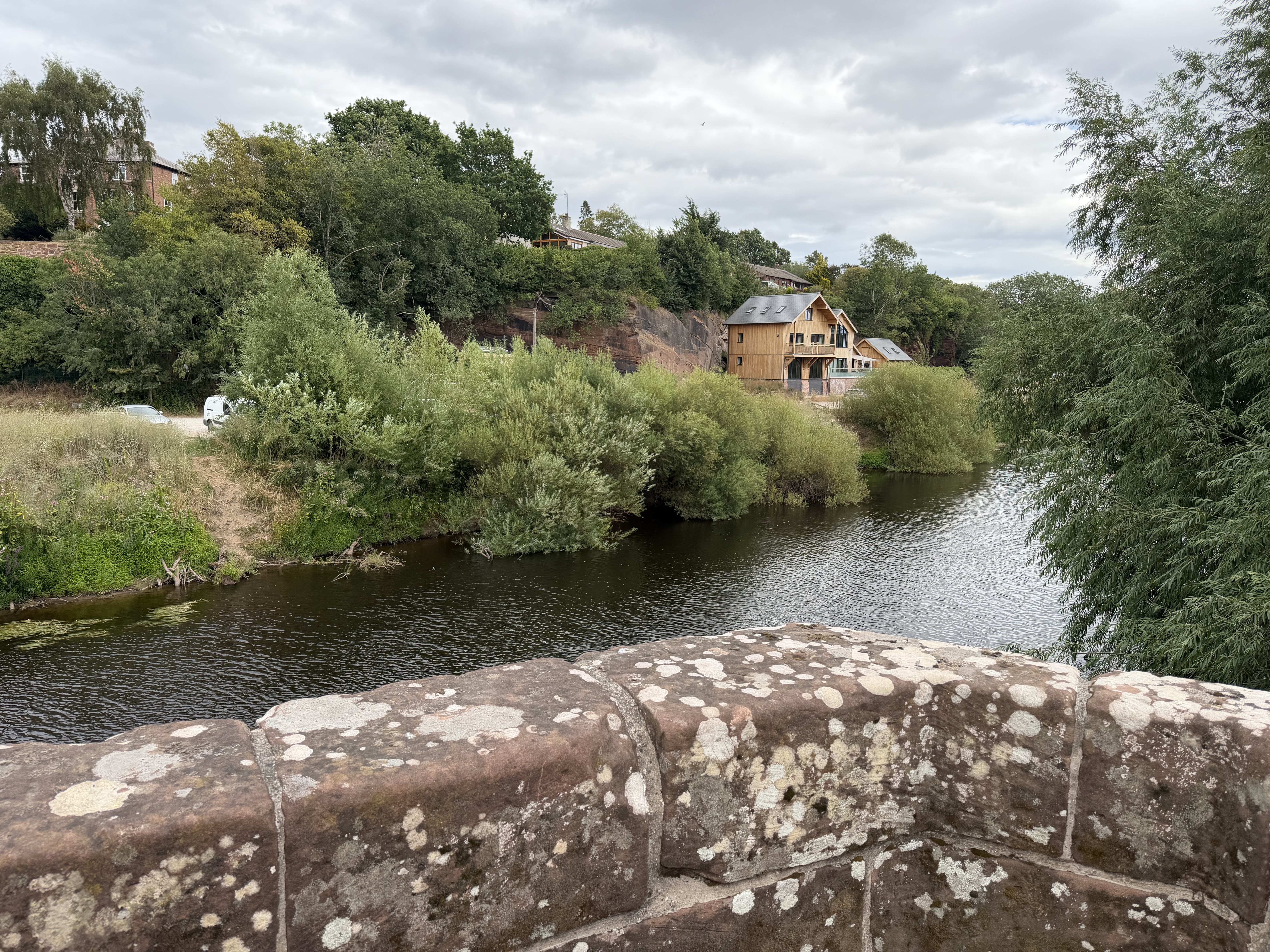
The author at St. Chad's in Over (from The Legend of Over Church)